



A production line cannot wait for a late bus. Neither can a construction site preparing for a morning safety briefing, an office team covering customer calls, or a warehouse receiving an early delivery. When employees arrive in small groups at different times, transport becomes an operational issue, not simply an HR benefit.
Reliable employee transportation gives businesses control over how their people reach the workplace. It helps teams arrive together, reduces uncertainty around public transit connections, and provides a practical option for worksites that are far from MRT stations or located in industrial areas. For companies operating multiple shifts, the right transport arrangement can protect productivity from the first pickup of the day to the final drop-off at night.
Why Employee Transportation Matters for Daily Operations
Employee attendance is often discussed as an individual responsibility. In reality, commute conditions can affect an entire team at once. Heavy rain, crowded connections, limited late-night services, and long walks from transit stops can create repeated delays. When several workers are late, supervisors may need to reassign tasks, delay handovers, or ask other employees to stay beyond their scheduled hours.
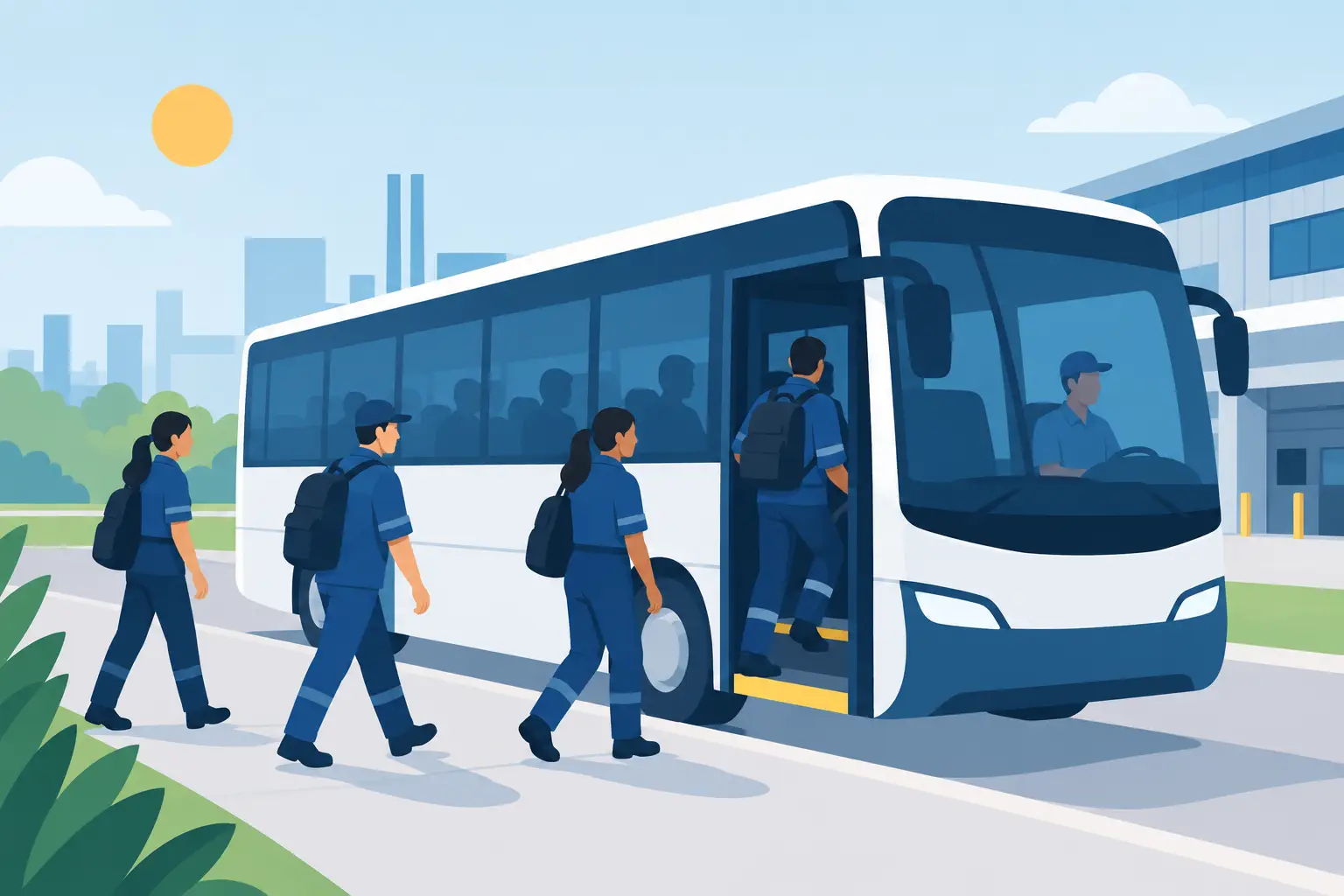
A dedicated staff shuttle replaces that uncertainty with a planned routine. Employees know where to wait, when the vehicle will arrive, and which route it will take. Site managers gain a clearer view of expected arrivals, while HR and administrative teams have one transport partner instead of handling multiple ad hoc claims or last-minute ride bookings.
This is especially useful for factories, construction projects, dormitories, warehouses, and business parks. These locations may have changing access requirements, restricted entry points, or shift times that do not align neatly with public transportation schedules. A scheduled bus or minibus can be timed around the actual reporting hour rather than the nearest train timetable.
There is also a safety benefit. Workers traveling after late shifts should not have to wait alone for irregular transport, particularly in isolated industrial areas. A professionally driven vehicle with a confirmed pickup and drop-off plan gives both employees and managers greater peace of mind.
Choosing the Right Employee Transportation Setup
The best arrangement depends on headcount, work hours, pickup locations, and how stable the schedule is. A company with 35 employees starting at one factory gate every weekday needs a different solution from a contractor moving crews among several project sites.
Start with the number of passengers per shift. A 13-seat minibus can work well for a small office team, a specialist crew, or an airport movement. A 23-seat vehicle suits medium-sized groups, while a 40-seat bus is often more efficient for larger workforce movements from dormitories, MRT stations, or common residential pickup points.
Capacity should not be the only consideration. Leave room for changing headcount, personal bags, safety gear, or occasional visitors. Booking a vehicle that is full every day may look efficient on paper, but it leaves no flexibility when a new worker joins the team or a worker needs to bring equipment.
Fixed Routes for Predictable Shifts
A fixed route is usually the most cost-effective choice when employees report to the same location on the same schedule. Pickup points can be organized around dormitories, transport hubs, or neighborhoods where several team members live. The route should account for traffic patterns, passenger boarding time, and a reasonable buffer before the shift begins.
For example, a 7:30 a.m. shift should not have the bus arriving at the site at exactly 7:30. A buffer allows for security clearance, site entry, and unexpected road delays. The goal is punctual employees ready to work, not passengers arriving at the gate at the last possible minute.
Flexible Transport for Changing Worksites
Construction contractors and event teams often need more flexibility. Pickup locations may change as projects move, headcount may rise during key phases, and working hours can be adjusted with little notice. In these cases, a transport provider that can revise routes, add trips, or provide additional vehicles is more valuable than a rigid arrangement that only works under ideal conditions.
Flexibility does come with a trade-off. Frequent route changes can increase planning complexity and may affect cost. The practical approach is to keep a core route for regular workers while using additional point-to-point or hourly bookings for exceptional movements, site inspections, training sessions, or extra crews.
Plan Routes Around People, Not Just Maps
The shortest route is not always the most reliable route. A route planner should consider where workers are actually coming from, how long boarding takes, and which roads become congested at shift-change times. One extra pickup point may save employees a long walk, but too many stops can turn a direct ride into a slow morning circuit.
A useful route typically balances three factors: convenience for employees, on-time arrival at the worksite, and sensible vehicle utilization. Grouping passengers at a few well-chosen pickup points is often more efficient than collecting everyone at their doorstep. For remote sites, an MRT-station pickup can be a practical meeting point that reduces both travel time and cost.
It also helps to review the route after the first few weeks. Actual travel times may differ from estimates, and attendance patterns can change. A pickup point with only one regular passenger may no longer be worthwhile, while a growing team in another area may need an added stop.
Driver Professionalism Is Part of the Service
For recurring staff transport, the driver becomes a familiar part of the daily operation. Professional drivers do more than drive from point A to point B. They maintain punctual pickup times, understand safe boarding practices, follow site access instructions, and communicate clearly when there is an unavoidable delay.
Businesses should look for licensed, insured vehicles and drivers who are experienced with group transport. This matters when managing larger buses, employees carrying work equipment, or routes involving busy pickup areas. A clean, well-maintained vehicle also makes a difference to staff morale. Employees may accept an early pickup more readily when the ride is comfortable, organized, and dependable.
Clear communication is equally important. Supervisors should know who to contact for schedule adjustments, added trips, or urgent transport requirements. A provider available by phone, SMS, or WhatsApp can be particularly helpful when shift plans change outside standard office hours.
Control Costs Without Cutting Corners
Employee transport should be evaluated against the cost of unreliable attendance, overtime caused by late handovers, individual taxi reimbursements, and the administrative time spent coordinating alternatives. A recurring transport contract can offer more predictable budgeting than arranging last-minute trips each day.
That said, the cheapest vehicle is not automatically the best value. An undersized vehicle may require extra trips. An overlarge bus running with only a few passengers may create unnecessary expense. The right choice matches vehicle size to regular demand, then includes a plan for occasional increases in headcount.
Ask for transparent pricing based on the route, vehicle capacity, shift timing, and frequency of service. Early morning, late-night, cross-border, or multiple-location movements may require different planning. Clear terms help avoid surprises and make internal approval easier for operations and finance teams.
When One-Off Transport Makes Sense
Not every business needs a daily shuttle. One-off employee transportation is useful for company training, off-site meetings, airport transfers, corporate events, team-building activities, and temporary workforce deployments. Smaller groups may prefer a 6- to 13-seat MPV or van, while larger teams can travel together by minibus or bus.
For executive visitors or senior management, a premium MPV can provide a more comfortable experience without separating the journey from the broader transport plan. The key is to use the vehicle that fits the purpose. A workforce movement needs reliable capacity and practical timing; a VIP airport transfer may place greater emphasis on comfort, luggage space, and presentation.
Singapore Workers Transport supports both recurring staff routes and one-time group movements, making it easier for businesses to work with one transport partner as needs change.
Build a Transport Plan That Can Keep Working
A good staff transport plan is not fixed forever. Review passenger numbers, pickup times, route performance, and feedback from supervisors at regular intervals. Small adjustments made early can prevent repeated late arrivals, overcrowding, or avoidable costs.
Most importantly, treat transport as part of the workday. When employees can get to the site safely, comfortably, and on time, managers can focus less on who has not arrived and more on the work that needs to be done.