



A shuttle can be fully booked, professionally driven, and still fail the event if guests cannot find it, board it quickly, or arrive when the program starts. For organizers, knowing how to coordinate event shuttles comes down to controlling the small operational details: passenger demand, vehicle capacity, staging space, timing, and clear instructions.
Whether you are moving employees to a corporate gathering, guests from a hotel to a dinner venue, or participants between a convention center and an off-site activity, transport should feel simple to the people using it. That takes planning behind the scenes.
Start with the passenger movement, not the vehicle
The first question is not, “How many buses do we need?” It is, “Who needs to travel, from where, at what time, and with what level of certainty?” Build a simple movement plan before requesting a quote.
Separate passengers by origin, destination, and arrival window. A staff appreciation event, for example, may need an early route from a worksite, a second pickup from an MRT-adjacent meeting point, and late-night return trips for employees working different shifts. A corporate conference may need hotel loops in the morning but only a few return departures after dinner.
Use confirmed attendance where possible, then add a practical buffer. For a mandatory employee event, attendance may be predictable. For a voluntary function, a buffer of 10 to 15 percent can prevent the last few guests from being left behind. The right allowance depends on the group, venue access, and whether people can reasonably use public transport or taxis as a backup.
Do not assume every passenger carries only a small bag. Luggage for airport-linked events, exhibition materials, strollers, wheelchairs, sports equipment, or formalwear can change the usable capacity of a vehicle. Tell the transport provider early so the assigned vehicle is suitable.
Match vehicle capacity to real boarding conditions
A vehicle’s stated seat count is a starting point, not the whole plan. A 13-seat minibus can be ideal for a small executive group, a hotel transfer, or a controlled pickup point. A 23-seat bus may suit a departmental outing. For large workforces or venue shuttle loops, a 40-seat bus often reduces the number of departures and the amount of coordination required.
The trade-off is access. A larger bus moves more people per trip, but it needs adequate turning space, a legal drop-off point, and room to wait without blocking traffic. Some hotels, office towers, restaurants, and event venues have tight driveways where a minibus or multiple smaller vehicles will operate more reliably.
For VIP guests, speakers, or senior management, it may be sensible to separate transport from the main group. A premium MPV offers a quieter, more comfortable ride and avoids holding a full coach for a small party running on a different schedule. This is not about overcomplicating the operation. It is about protecting the schedule that matters most.
When planning the fleet, confirm these details with the venue and transport operator:
- The exact pickup and drop-off location, including the building entrance or loading bay
- Height restrictions, turning limits, security gates, and bus parking rules
- Whether vehicles can wait on-site or must return at a specified time
- Passenger luggage, mobility needs, and equipment requirements
- The contact person authorized to make on-the-day changes
Build a schedule around boarding time
Event schedules often account for driving time but underestimate boarding time. A group of 40 people may take several minutes to assemble, find the correct bus, load belongings, and settle in. If there is registration, security screening, or a large crowd leaving at once, that window grows quickly.
Set the shuttle arrival time earlier than the passenger reporting time. For a major pickup, having the vehicle in position 15 to 20 minutes ahead gives the driver time to identify the correct bay and gives your coordinator time to handle questions before the rush begins. At locations with strict access rules, allow more time.
Plan backward from the event’s non-negotiable moment. If the program begins at 9:00 a.m., decide when guests must be seated, when they should reach the venue, when the bus must depart, and when boarding should open. Add a realistic traffic buffer based on the route and time of day. In Singapore, rain, expressway congestion, school-hour traffic, and peak business-district access can all affect travel time.
Return trips need equal attention. Avoid announcing only one broad instruction such as “Shuttles leave after the event.” Give a departure schedule. For example, an early return at 8:30 p.m., a main departure at 9:15 p.m., and a final departure at 10:00 p.m. helps guests choose their ride and keeps vehicles from waiting indefinitely.
How to coordinate event shuttles at the pickup point
The pickup point is where a good transport plan becomes visible. Passengers should not need to guess which vehicle is theirs or call several people for directions.
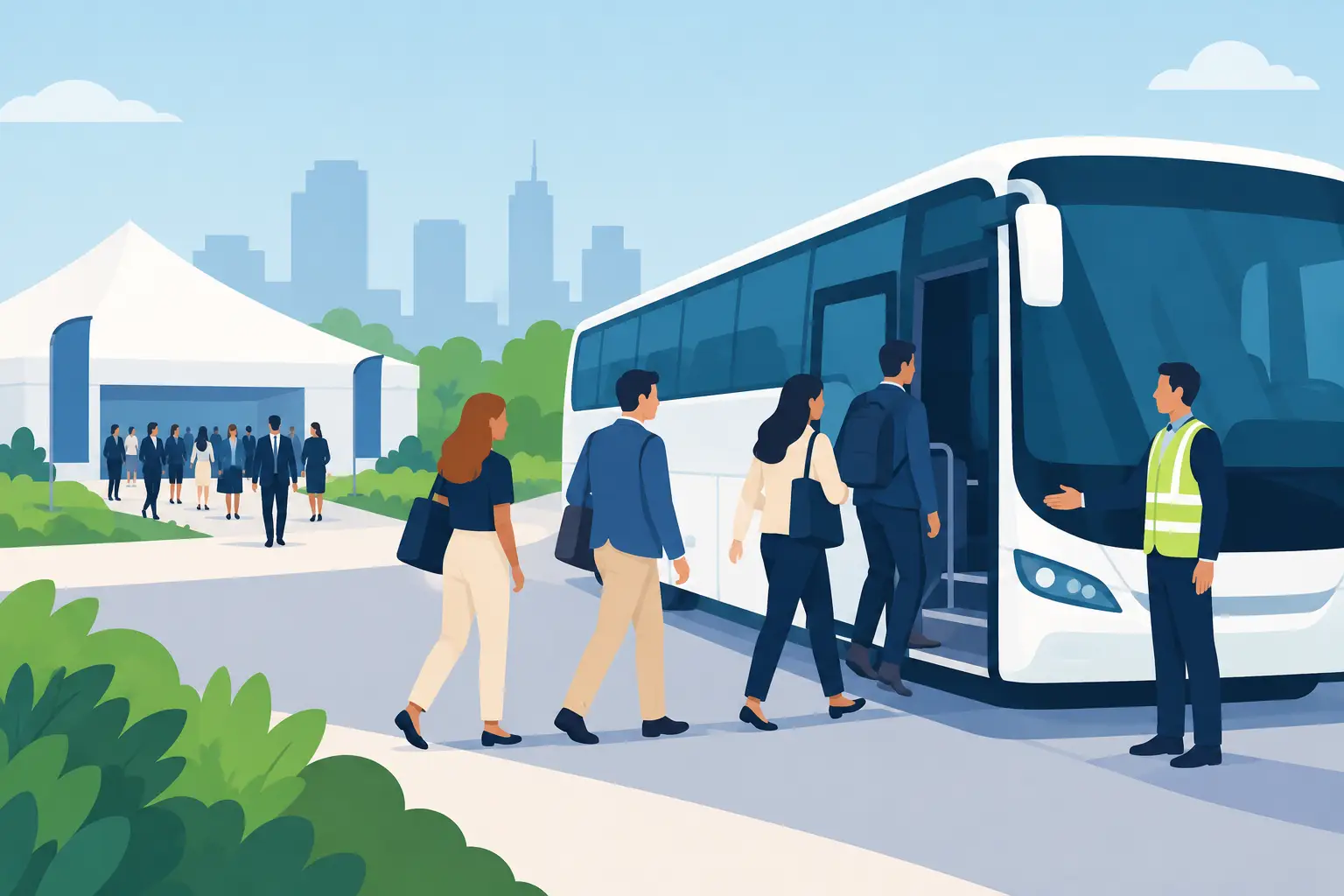
Use one clearly named meeting point and repeat it across every event communication. Include the address, entrance name, pickup time, and a short landmark if needed. “Level 1 coach bay near the west lobby” is much better than “outside the venue.” If the venue has multiple entrances, provide a map image through your event communication channel.
Assign an on-site transport coordinator for larger movements. This person does not need to manage every passenger personally. Their role is to confirm vehicle arrival, direct guests, keep an eye on headcount, and communicate changes to the driver or transport provider. A backup coordinator is valuable when the primary contact is occupied with registration or venue matters.
For multiple vehicles, use simple identifiers such as Bus A, Bus B, and VIP MPV. Match each identifier to a route or passenger group. Visible signs placed at the windshield or held by the coordinator reduce confusion, especially when several charter buses are using the same pickup area.
A passenger list can be helpful for employee transport, school groups, or restricted-access events. For open corporate functions, headcounts may be more practical than checking every name. Choose the method that fits the event. Strict check-in adds control but can slow down boarding.
Give drivers one accurate operating brief
Professional drivers can only act on the information they receive. Send one final operating brief before the event rather than relying on scattered messages. It should cover vehicle type, passenger count, pickup and drop-off points, reporting and departure times, route sequence, venue contact, and return-trip plan.
Also state what the driver should do if a group is late. Should the vehicle wait five minutes, call the coordinator, or depart at the scheduled time? Establishing this rule in advance prevents an uncomfortable decision at the curb.
Keep the driver’s role focused on safe, punctual transport. The event coordinator should handle passenger disputes, late attendees, and program changes. Clear responsibility prevents delays and allows the driver to concentrate on traffic conditions, safe stopping points, and vehicle operations.
For recurring corporate events or multi-day programs, use the first day as an operational test. Record actual departure times, passenger counts, waiting issues, and access problems. Adjust the next day’s schedule instead of repeating the same friction.
Plan for changes without overpaying for them
No event transport plan is completely fixed. A meeting may run late, a flight may be delayed, or a sudden downpour may change where guests can wait. The practical response is not to reserve excess vehicles for every possibility. It is to identify the risks that would have the greatest impact and agree on a response path.
For a high-priority event, ask about standby options, additional trips, or the ability to extend a booking by the hour if needed. This is particularly useful for airport transfers, executive roadshows, and events ending late at night. For budget-sensitive staff events, a fixed departure policy may be more appropriate than paying for indefinite waiting time.
Singapore Workers Transport can support one-time event transfers as well as larger group and recurring staff transport requirements, with vehicles ranging from MPVs to minibuses and buses. Providing your event details early makes it easier to recommend a practical vehicle mix and route arrangement.
The best shuttle plan is the one guests barely notice. They receive clear instructions, find the right vehicle, board safely, and arrive ready for the event. Give the transport operation that level of attention, and your schedule has a much better chance of holding when the day gets busy.