


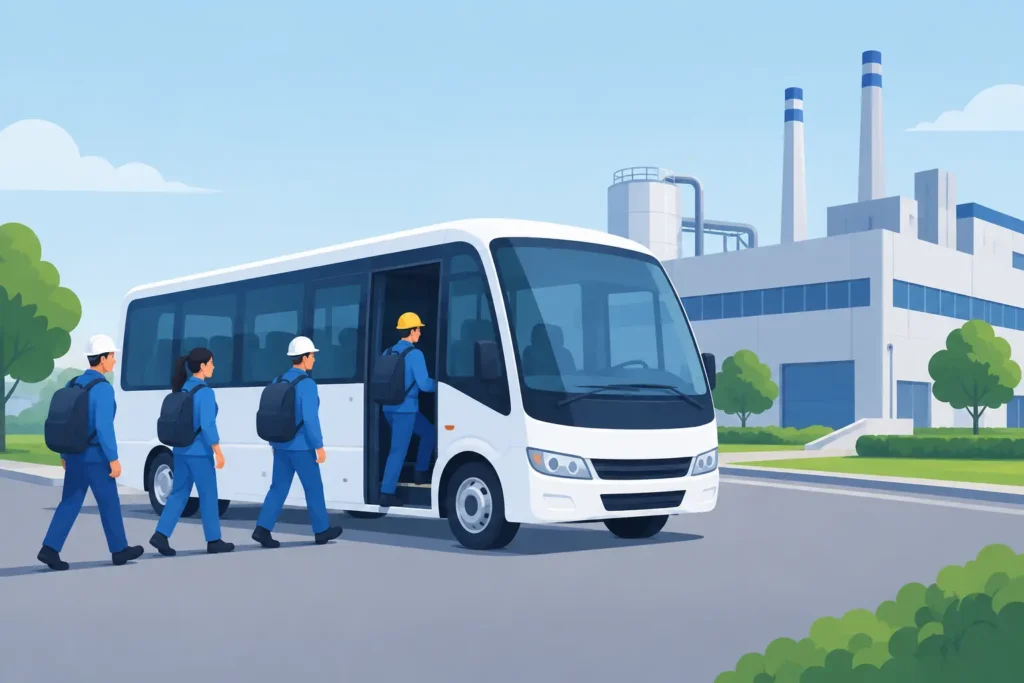
A late bus at 6:45 a.m. can delay an entire production line. This factory shuttle example shows how a Singapore manufacturer can move workers from several pickup points to a worksite on time, without asking supervisors to solve transport problems before every shift.
The objective is not simply to fill seats. A good staff shuttle arrangement has to match shift timing, worker locations, vehicle capacity, site access rules, and changing headcount. When those details are planned together, employees arrive more safely and consistently, while the company gets better control over attendance and transport spending.
A factory shuttle example for a three-shift operation
Consider a manufacturing facility in Tuas with 86 employees working across three daily shifts. Many employees live in western and northern Singapore, while some stay in dormitories near Kranji and Woodlands. Public transport can work for some workers, but it is less practical for the 7:00 a.m. opening shift and the 11:00 p.m. end-of-shift movement.
The operations manager sets up a recurring shuttle plan with two morning pickup routes, one afternoon route, and one late-night return route. The service uses a 40-seat bus for the largest group and 23-seat minibuses for smaller groups. Instead of sending one oversized vehicle on a long island-wide loop, the routes are grouped by where employees actually live.
The first morning bus starts at a Woodlands pickup point at 5:55 a.m., makes two controlled stops near worker housing, and reaches the Tuas facility by 6:40 a.m. A second 23-seat minibus collects employees from a Jurong West route and arrives by 6:45 a.m. That 15-minute buffer allows workers to clear security, change, and report to their stations before the shift begins.
For the evening and night movements, the same principle applies. Departure time is based on when workers can realistically leave the production floor, not just the official shift-end time. If a shift ends at 11:00 p.m., scheduling the bus at 11:02 p.m. may cause unnecessary pressure and late departures. A 11:15 p.m. departure can be more dependable when it accounts for handover, locker access, and security clearance.
Start with shift requirements, not a vehicle size
A factory transport plan often goes wrong when the first question is, “How many seats do we need?” Capacity matters, but it comes after the operating requirement is clear. The better starting point is to map every shift, reporting deadline, employee pickup area, and facility entry procedure.
For each shift, identify how many employees need transport, where they board, and what time they must be at the gate. Separate regular riders from occasional riders. A bus that appears full on a roster may carry fewer people on Fridays, during school holidays, or when overtime is reduced. On the other hand, a contractor onboarding period may create a temporary increase that needs a second vehicle.
The Tuas example has 52 employees requiring transport for the morning shift, 21 for the afternoon shift, and 13 for the overnight group. This does not automatically mean one 40-seat bus and one 13-seat vehicle. The worker locations may make two smaller routes more efficient, especially if one large bus would spend too much time navigating separate pickup zones.
A 13-seat minibus is often suitable for a stable, localized team. A 23-seat minibus works well for a dormitory route or a single large residential cluster. A 40-seat bus is a practical choice when a company has a larger shift group and pickup points can be kept along a logical corridor. The right mix depends on route density, not just the headcount on paper.
Build in realistic time buffers
Punctual transport requires room for normal operating conditions. Morning traffic, rain, a delayed worker at a controlled pickup point, and security checks can all affect arrival time. The goal is not to make employees wait excessively at the site. It is to avoid building a schedule that only works on a perfect day.
For factory shifts, a 10- to 20-minute arrival buffer is commonly sensible, depending on the size of the site and the reporting process. Larger industrial sites may need more time because workers walk from the drop-off point to a locker room, canteen, or assigned production area. A smaller warehouse with direct entry may need less.
Pickups also need discipline. Each stop should have a clear location, a scheduled time, and a named site contact if the stop is inside a dormitory or private facility. Adding informal stops may feel helpful at first, but over time it can turn a dependable route into an unpredictable one.
Route design should protect attendance and productivity
A factory shuttle is part of the attendance plan. When workers have a reliable way to reach an industrial site, supervisors spend less time handling late-arrival calls and production teams can begin with the right manpower in place.
In the example above, the operations manager reviews attendance data after the first month. One pickup point has only three regular riders, but it adds 18 minutes to the route during peak traffic. Rather than keep the stop out of habit, the manager discusses alternatives with the affected employees: a nearby pickup point within walking distance, a feeder arrangement, or a separate smaller vehicle if the group grows.
This is where route flexibility matters. A transport contract should not be treated as fixed forever. Headcount changes, worker accommodation shifts, and project schedules move. A provider should be able to adjust pickup timing, vehicle capacity, or route order when the operational case supports it.
At the same time, frequent changes create confusion. The practical approach is to review routes on a regular schedule, such as monthly or after a major manpower change, rather than altering stops every week. Communicate changes clearly before they take effect, especially for night-shift teams who may not see office notices during standard business hours.
Manage safety and site access from the beginning
For industrial transport, safety is not limited to the journey. It also includes boarding, drop-off, and movement around the facility. The designated bus bay should be away from heavy vehicle traffic where possible, with enough room for workers to alight without crossing an active loading area.
Drivers should know the correct entry gate, waiting zone, and site speed requirements before the first service day. They should also have a direct contact for the site supervisor or security team if there is an access issue. Professionally driven, licensed, and insured vehicles give businesses greater confidence, but the site-specific plan remains essential.
For late-night routes, consider lighting at pickup and drop-off points, worker visibility, and how long passengers may be waiting. A driver should not be pressured to depart early because a few riders are ready, leaving others behind. Clear departure rules protect fairness and reduce avoidable disputes.
Control costs without making the route unworkable
The lowest quoted transport price is not always the lowest operating cost. A poorly planned shuttle can lead to overtime disruptions, absenteeism, missed handovers, and repeated last-minute taxi claims. Those costs are rarely visible on the transport invoice, but they affect the business.
Cost control comes from matching the fleet to real demand and keeping routes efficient. A company may save money by using a 23-seat minibus for a small night-shift group instead of retaining a 40-seat bus after the morning run. It may also reduce dead mileage by arranging a vehicle to begin near the first pickup zone rather than traveling empty across the island.
Ask for pricing that reflects the actual service requirement: daily or recurring use, route duration, expected mileage, number of trips, waiting time, and any special site access needs. Be clear about whether the service covers only scheduled runs or also provides support for overtime, emergency replacement transport, or ad hoc worker movements.
Singapore Workers Transport can arrange customized workforce routes using 13-, 23-, and 40-seat vehicles for recurring staff pickup and drop-off needs. For companies with changing shift patterns, the ability to coordinate directly by call, SMS, or WhatsApp helps resolve operational issues quickly.
A simple rollout process for operations teams
Before launch, confirm the employee list, pickup points, contact persons, reporting time, and facility entry instructions. Share the schedule with workers in a format they can easily keep on their phones, and ask them to arrive a few minutes before the stated pickup time.
Run the first week as an observation period. Track actual departure and arrival times, passenger counts, missed pickups, and feedback from site supervisors. Do not judge the route only by whether the bus arrives. Check whether employees can reach their work areas calmly and whether the driver has enough time to complete the run safely.
After that first week, make only the adjustments supported by real data. A factory shuttle works best when it becomes a dependable routine: workers know where to wait, supervisors know when teams will arrive, and the transport provider knows exactly what the site requires.
The most useful factory shuttle example is one that can be adapted to your own shift roster. Start with the workers who need transport most, protect the arrival buffer, and let actual route data guide the next decision.