


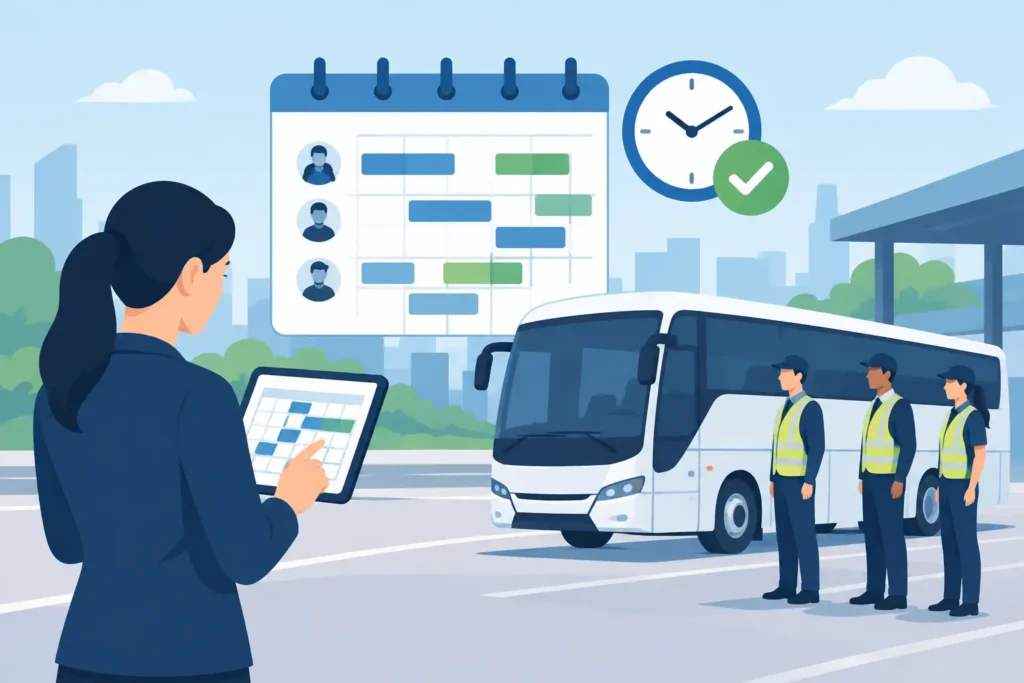
A 7:00 a.m. shift does not start at 7:00 a.m. if half the team is still waiting at a pickup point. For operations teams, knowing how to schedule shift transport means working backward from the time employees must be ready at the gate, briefing room, factory floor, or worksite. The goal is not simply to fill a bus. It is to deliver the right people, to the right location, safely and on time, every day.
Shift transport becomes especially demanding when staff live across multiple areas, work overnight, carry tools or uniforms, or need to reach sites with limited public transit. A practical schedule accounts for those realities before the first vehicle leaves the depot.
Start With the Shift, Not the Route
The most common planning mistake is to begin by drawing a route on a map. Start with the operating schedule instead. Confirm each shift’s reporting time, handover requirements, security check-in process, and the actual walking time from the drop-off point to the work area.
If employees must clock in at 7:00 a.m., a vehicle arriving at the site at 7:00 a.m. is already late. A better plan might set a 6:40 a.m. arrival, allowing time for alighting, site registration, changing, and an unexpected queue at the entrance. For construction sites and industrial facilities, this buffer can be the difference between a calm start and a delayed crew.
Build separate transport plans for each shift rather than copying the day-shift route. Night-shift staff may have different pickup needs, fewer public transport alternatives, and greater concerns around safety at pickup points. Split shifts may also require more flexible vehicle deployment than a standard morning and evening shuttle.
Gather the Details That Determine the Schedule
A reliable transport schedule is based on current employee information, not last year’s headcount. Before assigning vehicles, collect the details that affect capacity, journey time, and service reliability.
For each shift, confirm the number of passengers, their pickup zones, shift start and finish times, worksite entrance, and whether they travel with equipment or bulky personal items. Also identify employees who need a closer pickup point, such as workers with mobility needs or those finishing a late-night shift.
A complete transport brief should include:
- Shift reporting and release times, including the required early-arrival buffer
- Pickup addresses or agreed neighborhood meeting points
- Passenger numbers by stop and expected growth in headcount
- Worksite access instructions, gate restrictions, and approved drop-off areas
- A contact person for the site, the transport coordinator, and each vehicle
This information should be reviewed regularly. Staff assignments change, dormitory occupancy changes, and a route that worked for 18 passengers may become inefficient when the team grows to 28.
How to Schedule Shift Transport by Pickup Zone
Group passengers by location first, then test the route against the reporting time. In a compact city, it can be tempting to collect workers from many scattered stops on one trip. That may reduce the number of vehicles on paper, but it can create a long ride for the first passengers picked up and leave no room for traffic delays.
As a general rule, use a central pickup point where several employees live nearby, rather than stopping at every block. The meeting point should be safe, easy for a bus or minibus to access, and simple for drivers to identify. It should also be realistic for workers arriving before dawn or after midnight.
Keep routes geographically tight. A vehicle serving the west should not detour to the northeast for two additional passengers unless the shift timing and cost savings clearly justify it. In many cases, two shorter routes are more dependable than one overloaded route crossing the island.
Route design is a trade-off between convenience, cost, and punctuality. Door-to-door pickup can be useful for small executive groups, passengers with special requirements, or isolated locations. For larger workforce movements, designated stops usually provide better time control and more predictable operating costs.
Match Vehicle Capacity to Real Passenger Demand
Select a vehicle based on occupied seats, not only the registered staff list. Attendance can vary due to leave, overtime, new hires, or temporary workers. At the same time, scheduling a 40-seat bus for 14 workers every day may add unnecessary cost.
For smaller teams, a 6- to 13-seat vehicle may suit a single pickup zone or a late-night support route. A 13-seat minibus works well for compact teams and flexible movements. For higher-volume routes, 23-seat and 40-seat buses can move a full shift efficiently while reducing the number of vehicles entering a worksite.
Leave a sensible margin for operational changes. If a 13-seat vehicle is routinely carrying 13 passengers, one new employee or one supervisor joining the route can disrupt the schedule. A small capacity buffer also helps when a vehicle requires maintenance and passengers need to be reassigned quickly.
Consider comfort alongside capacity. Employees traveling long distances before physical work need adequate seating, air conditioning, and enough room to board without delays. A packed vehicle may appear efficient, but it can lead to late departures, complaints, and an unpleasant commute.
Set Pickup Times With Realistic Buffers
Transport schedules fail when they assume ideal road conditions. Build timing around normal traffic patterns, known congestion points, school-zone activity, site access queues, and weather disruptions. The early-morning route may be fast one day and delayed the next by roadworks or an accident.
For recurring services, conduct a route trial before confirming the final pickup times. Record the actual travel time between stops, the time needed for passengers to board, and the delay at the worksite gate. Then add a reasonable buffer based on the route’s risk level. A route with one direct expressway segment needs a different allowance than a route with seven neighborhood stops.
Avoid telling every passenger to arrive at the pickup point exactly when the vehicle is due. Ask staff to be ready five to 10 minutes earlier, while instructing drivers not to depart before the stated time unless all assigned passengers are accounted for. This creates discipline without making early arrivals wait too long.
For return trips, confirm whether all employees finish at the same time. Overtime, staggered releases, and shift handovers can make one return bus impractical. A scheduled main departure with a smaller later vehicle may be more cost-effective than keeping a large bus and driver waiting for a few passengers.
Give Drivers and Employees One Clear Communication Plan
Even a well-designed route needs clear communication. Employees should know their route number or vehicle description, pickup point, scheduled time, and who to contact if they will be absent or delayed. Drivers need a current passenger list, route sequence, site instructions, and an operations contact who can make decisions quickly.
Use one approved channel for schedule updates. WhatsApp or SMS can work well for daily coordination, particularly when staff need immediate notice of a pickup-point change or vehicle replacement. Keep messages short and specific: state the route, date, revised time, and action required.
Do not rely on informal word-of-mouth updates between workers. A change that reaches only part of the team can result in missed pickups and unnecessary vehicle waiting time. For larger accounts, a site supervisor or HR coordinator should confirm changes to headcount and shift timing before the transport provider dispatches vehicles.
Prepare for Disruptions Before They Happen
The best schedules include a response plan for late staff, vehicle issues, severe weather, and sudden workforce changes. This does not mean paying for unused vehicles every day. It means agreeing in advance on who authorizes an extra trip, where passengers should wait if a vehicle is delayed, and how updates will be sent.
A transport partner with licensed, insured drivers and a varied fleet can provide useful flexibility when requirements change. Singapore Workers Transport can arrange recurring staff routes alongside one-time or hourly vehicle support, which is helpful during peak production periods, training days, site relocations, or large recruitment intakes.
For critical shifts, identify a backup option. It may be a reserve vehicle, a second pickup route, or a defined process for arranging a maxicab when a small group cannot fit on the scheduled bus. The right choice depends on how costly a late shift start would be compared with the cost of standby capacity.
Review Performance Every Week
A shift transport schedule should be managed like any other operating process. Review actual arrival times, no-shows, passenger complaints, overtime patterns, and vehicle utilization. If the same bus is consistently early, the route may be leaving too soon. If it is repeatedly late, the issue may be an unrealistic timetable, too many stops, or a site-access bottleneck.
Ask drivers for feedback as well. They see the boarding patterns, unsafe pickup behavior, inaccessible stops, and traffic conditions that do not appear on a spreadsheet. Their observations can help refine the schedule without adding vehicles.
The most dependable shift transport plans are not fixed forever. They are clear enough for employees to trust, flexible enough for operations to adapt, and reviewed often enough that small delays do not become a daily problem. When the next shift has to start on time, a schedule built around real conditions gives everyone a better chance of arriving ready to work.