


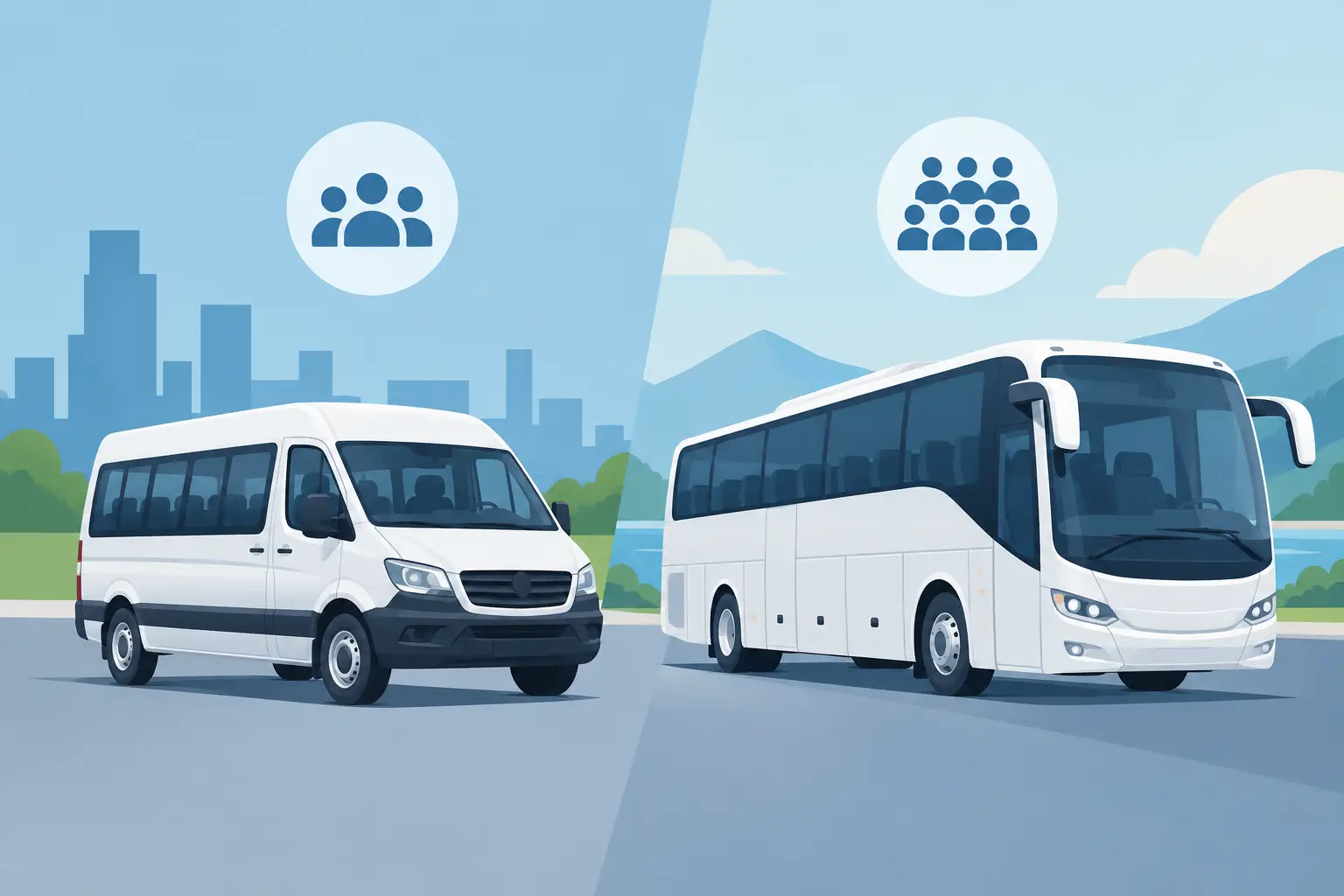
A vehicle that is too small creates late arrivals, extra trips, and frustrated employees standing at the pickup point. A vehicle that is too large can raise the cost of every shift without improving the journey. When comparing minibus versus coach capacity, the right answer comes down to actual passenger numbers, route conditions, shift patterns, luggage, and how much flexibility your operation needs.
For Singapore workforce transport, capacity is not just a seat count on a brochure. It affects whether workers reach a construction site before toolbox briefing, whether a factory shift change runs smoothly, and whether your transport budget stays predictable month after month.
Minibus versus coach capacity at a glance
A minibus is generally the practical choice for small to mid-sized groups. For recurring staff transport, common options include 13-seat and 23-seat minibuses. They work well for office teams, dormitory pickups, smaller work crews, airport groups, school movements, and event transfers where the group size is known but not large enough to fill a full-size bus.
A coach, often referred to as a 40-seat bus for local group transport, is built for larger passenger movements. It is suited to factory workforces, multiple pickup points, large event delegations, company outings, and shift transport where 30 or more people need to travel together.
The difference seems simple: a 13- or 23-seater carries fewer people than a 40-seater. In practice, selecting between them means balancing capacity utilization with route efficiency. A 40-seat coach carrying 18 passengers may be comfortable, but it may not be the most cost-effective option. Conversely, squeezing 15 people into a 13-seat arrangement is not an option. It creates a safety and compliance issue before the vehicle even leaves.
Start with the passenger count, then add a buffer
Count confirmed riders rather than relying on your total headcount. Not every employee starts from the same location, works the same shift, or uses company transport on every day. For recurring contracts, review attendance by shift and pickup zone over at least a few weeks. This gives a more realistic view of demand than a one-day estimate.
A small buffer is sensible, especially when new workers join, staff rotate between sites, or public transport disruptions increase ridership. If your usual load is 11 or 12 passengers, a 13-seat minibus may work, but it leaves little room for change. A 23-seater can provide breathing room and avoid arranging a second vehicle at short notice.
For groups regularly reaching 28 to 35 passengers, a 40-seat coach is often the cleaner operational choice. It keeps the team together, reduces the coordination burden on supervisors, and limits the risk of a late second run delaying the start of work.
Capacity is based on seats, not standing room
Every passenger needs a proper seat. For booked private transport, planning around standing passengers is neither a safe nor workable way to manage a group. The vehicle should be selected based on seated capacity, with particular attention to seat belts, boarding access, and the needs of elderly passengers, children, or employees carrying work equipment.
If the group includes a wheelchair, folding mobility aids, bulky tools, cartons, bicycles, or other items, available seating can be reduced. Tell the transport provider before booking so the right vehicle and loading arrangement can be planned.
When a minibus is the better fit
A minibus is often the most efficient option when your route serves a focused group. A 13-seat vehicle is suitable for executive teams, site supervisors, airport arrivals, small department transfers, and crews traveling from one dormitory or meeting point. It is also easier to position at hotels, office drop-off zones, narrow access roads, and busy pickup areas.
A 23-seat minibus gives more room for growing teams without moving immediately to a full coach. It is a strong middle ground for a single work crew, a corporate event group, a school activity, or a staff shuttle with moderate daily demand. For businesses with several smaller pickup clusters, two minibuses may sometimes be more useful than one coach because each vehicle can take a direct route.
That route flexibility matters in Singapore. A large coach may be ideal on a straightforward industrial route, but a smaller vehicle can be faster where access is restricted, road space is tight, or passengers are spread across several locations. Fewer detours mean less time on the road and more reliable arrival times.
Minibuses can also be the sensible choice for shift operations with changing headcounts. If night-shift demand falls below daytime levels, assigning a smaller vehicle to the quieter run can control costs while maintaining a safe and comfortable commute.
When a coach makes more sense
A coach earns its place when consolidating trips improves the operation. A 40-seat bus is particularly useful for factories, construction projects, warehouses, and large offices where many employees finish or begin work at the same time. One coordinated vehicle arrival is easier for a site supervisor to manage than several separate minibuses arriving at different intervals.
For long routes or cross-border group travel, a coach also gives larger teams the benefit of traveling together. This is helpful for company outings, training days, large meetings, Johor trips, and airport movements involving a full delegation. Keeping the group in one vehicle simplifies headcounts, departure instructions, and communication when schedules are tight.
However, a coach requires suitable pickup and drop-off access. Before scheduling one, check whether the worksite, hotel, venue, dormitory, or loading area can safely accommodate its turning radius and stopping space. A large vehicle parked in the wrong place can block traffic or force passengers to walk farther than planned. Good transport planning considers the last 100 yards, not only the distance between two addresses.
Do not pay for empty seats by default
More capacity is useful only when it supports your daily operation. If a 40-seat coach is only half full for most runs, a 23-seat minibus or a revised route may offer better value. On the other hand, splitting 38 passengers across two smaller vehicles can cost more and introduce additional coordination risk than booking one coach.
The best choice is usually the one with the fewest unnecessary trips, reasonable seat utilization, and enough reserve capacity to handle normal changes. Price matters, but late arrivals, repeated dispatch changes, and poor rider experience also carry a cost.
Consider luggage, equipment, and trip purpose
Passenger capacity can look very different once bags are added. A 13-seat minibus may be ideal for a local point-to-point staff movement with light personal belongings. The same vehicle may not suit 13 airport passengers with large suitcases, or a project team carrying samples, safety gear, and presentation equipment.
For airport transfers, tours, cross-border trips, and event travel, provide the number of passengers and a realistic description of luggage. A smaller group may need a larger vehicle because cargo space is the deciding factor. For VIP or management travel, a premium MPV can offer greater comfort for six to seven passengers, but it is not a substitute for a minibus when the group and luggage load are larger.
Trip duration matters too. A short shuttle from a dormitory to a nearby site places different demands on the vehicle than a full-day corporate itinerary. Longer journeys benefit from adequate personal space, comfortable seating, and a vehicle size that does not leave passengers crowded with bags underfoot.
Build capacity around your shift schedule
Many transport problems are caused by timing rather than total headcount. A business may have 60 employees using transport each day, but only 20 travel at 7:00 a.m., another 20 at 8:00 a.m., and the rest on a night shift. Booking two 40-seat coaches because the overall number is 60 would not solve the actual requirement.
Map each shift separately. Record the pickup locations, required arrival time, number of riders, and expected return journey. Then identify whether passengers can be grouped without causing excessive ride times. A route with 22 riders may suit a 23-seat minibus, while another route with 37 riders is a natural match for a 40-seat coach.
For recurring worker transport, revisit this plan whenever a site opens, staffing changes, or shift patterns are revised. A route that was efficient three months ago may no longer be the right fit. Regular adjustments keep transport affordable and help maintain punctual service.
Questions to ask before you book
Before confirming a minibus or coach, establish four practical details: the number of seated passengers, the amount of luggage or equipment, the pickup and drop-off access, and the exact schedule. These details allow the transport provider to recommend a vehicle based on the journey rather than simply the largest option available.
It is also worth asking whether demand changes by day. Monday morning, Friday evening, public holiday eves, and rotating shift schedules can all affect passenger numbers. For a one-time event, collect confirmations early. For a daily shuttle, use actual ridership records and keep a contact person available for urgent changes.
Singapore Workers Transport can plan 13-seat, 23-seat, and 40-seat options around recurring staff routes or one-time group movements, with professional drivers and scheduling support for early, late, and overnight operations.
The most useful capacity decision is the one that gets every passenger to the right place safely, on time, and without paying for space your operation will not use. Start with the real journey, not the biggest vehicle, and your transport plan will be easier to manage from the first pickup onward.