


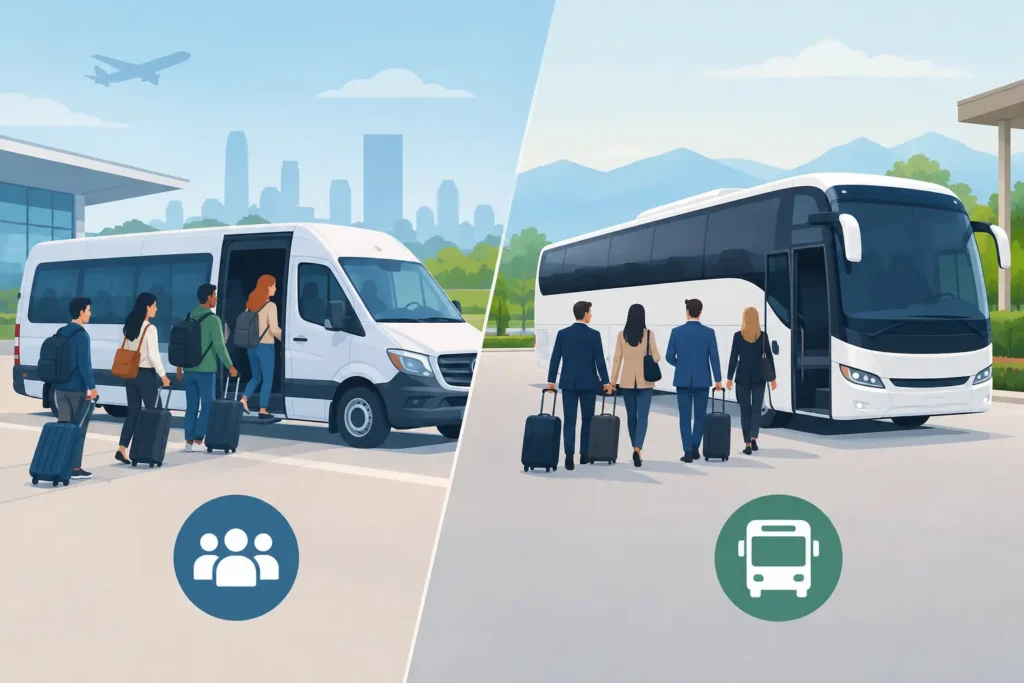
A late shuttle can hold up a factory handover, leave a night-shift team waiting at the gate, or start an airport transfer with unnecessary stress. The shared shuttle versus private charter decision is not simply about choosing the lowest fare. It affects attendance, arrival times, staff comfort, route control, and how easily your transport plan can adapt when operations change.
For Singapore businesses moving employees daily, the right answer depends on whether your group can work around a fixed schedule or needs a vehicle planned entirely around the worksite. For event organizers, families, and corporate travelers, luggage, pickup points, and service expectations also matter. Here is a practical way to make the choice.
What Is a Shared Shuttle?
A shared shuttle carries passengers from more than one booking, employer, location, or stop. It normally runs on a planned route and timetable, with passengers joining at designated pickup points. Because vehicle and operating costs are spread across more riders, it can be an affordable option for regular journeys where timing is predictable.
This model works best when staff live near the same pickup points, work the same shift, and can arrive a little earlier than their actual reporting time. A shared service may also suit attendees traveling to the same conference venue or travelers going to an airport during a similar departure window.
The trade-off is control. The shuttle must account for other passengers, so it may make additional stops or follow a route that is not the fastest path for every rider. If one group’s shift ends early, if a site gate changes, or if passenger numbers fluctuate sharply, a shared route may not be able to change immediately.
What Is a Private Charter?
A private charter reserves the vehicle and driver for your organization or group. You select the pickup location, destination, reporting time, passenger capacity, and route requirements. For recurring staff transport, this can include a customized daily pickup and drop-off plan for factories, offices, construction sites, dormitories, and industrial facilities.
A charter can be arranged as a one-way transfer, return trip, full-day hire, airport movement, event transport, or a long-term employee shuttle contract. The vehicle is dedicated to your booking, which gives the organizer more direct control over the service.
Private does not have to mean luxury-only or oversized. A small management team may need a 6- or 7-seat MPV for a site visit, while a larger workforce may need a 23- or 40-seat bus. The practical question is whether the vehicle size and schedule fit the group without paying for unused seats.
Shared Shuttle Versus Private Charter for Staff Transport
For workforce mobility, punctuality is usually the deciding factor. If a late arrival affects shift deployment, safety briefings, production targets, or access arrangements, a private charter often offers better operational certainty. The driver follows your agreed plan rather than balancing pickups for multiple unrelated groups.
A private arrangement is especially useful for early morning, late-night, rotating, or split shifts. Public transportation may be less convenient at those hours, and shared transport can become difficult when the same employees do not travel on the same schedule every day. A dedicated charter can collect workers from practical points and bring them directly to the correct gate or designated drop-off area.
Shared shuttles can still make sense for stable, high-volume commuting. For example, if employees report to one office at a consistent weekday time and live close to a common MRT station or housing area, a fixed shared route can manage costs well. The service is easiest to run when the passenger list, route, and reporting time rarely change.
The key is to calculate the real cost of disruption, not only the transport rate. Saving money on a shared service may not help if repeated delays lead to overtime, idle crews, missed handovers, or complaints from employees who have long waits after shift.
Compare Cost Beyond the Quoted Rate
Shared shuttles typically have a lower per-person cost because the vehicle is used by multiple passengers. This can be attractive for individual travelers, small teams, or organizations with a flexible commute policy. It is also useful when passenger demand is steady enough to keep seats filled.
A private charter has a higher booking cost because the vehicle, driver, and time are reserved for one group. However, the cost per passenger can become competitive when a full minibus or bus is transporting a larger team. For daily staff transport, predictable contract arrangements can also make budgeting easier than frequent ad hoc bookings.
When comparing prices, account for the full operating picture: the number of pickup points, waiting time, parking or entry requirements, luggage, peak-hour travel, shift patterns, and whether the vehicle must remain on standby. A point-to-point transfer for a 10-person group is very different from an eight-hour charter that includes multiple site movements.
It is also worth checking the effect of no-shows. With a shared shuttle, unused seats may have little impact on the operator’s route. With a private charter, your business is reserving the full vehicle, so accurate passenger forecasts help you select the right capacity and avoid overbooking.
Route Flexibility and Timing Control
A shared shuttle follows the needs of the route as a whole. Stops are generally fixed, and pickup times may include a buffer for traffic and other passengers. That structure is useful when everyone accepts the same timetable, but it can be limiting for operations that change at short notice.
Private charters are better suited to specific access needs. A construction contractor may need workers dropped at a particular entrance before a toolbox meeting. A corporate administrator may need to collect visiting staff from Changi Airport, bring them to a hotel, then move them to several office locations. An event organizer may need staggered returns after a dinner or conference.
Singapore traffic, roadworks, venue restrictions, and peak-hour congestion can affect any journey. The advantage of a dedicated vehicle is that the transport plan can be built around your priority. If arriving before a shift begins matters more than collecting from several distant neighborhoods, the route can reflect that.
Capacity, Comfort, and Luggage
Vehicle selection should be based on passengers and what they carry. A standard employee commute may only require seats and reasonable personal space. An airport group may need room for suitcases. A school outing, tour, or sports group may have equipment, strollers, bicycles, or bulky items that change the vehicle requirement.
For smaller groups, MPVs such as Toyota Noah, Voxy, Alphard, Vellfire, and Mercedes-Benz Viano can provide comfortable point-to-point travel. Toyota HiAce vans are practical for groups that need more seats and luggage capacity. For workforce movements, 13-seat minibuses and larger 23- or 40-seat buses are often a more efficient choice.
Comfort also means avoiding an overcrowded plan. If a team is traveling after a physical shift or before an early start, enough seating and a direct route can support morale as well as punctuality. For executive visitors or VIP airport transfers, a premium private vehicle may be appropriate even when a shared option costs less.
When Each Option Is the Better Fit
Choose a shared shuttle when your passengers have similar schedules, can use common pickup points, and do not need frequent route changes. It is a sensible choice for routine commuting where cost per rider is the main priority and a fixed timetable is acceptable.
Choose a private charter when your group needs direct travel, a specific pickup time, controlled stops, or a vehicle sized for its exact requirements. It is usually the stronger option for shift workers, multiple worksite movements, airport groups with luggage, corporate events, school transport, cross-border trips, and journeys where late arrival creates a real operational problem.
There is also a middle ground. Some businesses use a dedicated private charter for critical shift movements and shared transport for office-based employees with flexible start times. Others begin with a smaller private vehicle for a pilot route, then increase capacity once ridership is established.
Before booking, confirm passenger numbers, pickup addresses, reporting times, destination access instructions, luggage needs, and whether the service is one-time or recurring. A transport provider can then recommend a practical vehicle and route rather than forcing your group into a generic schedule.
Singapore Workers Transport supports both recurring staff shuttle plans and one-time private group bookings, with professionally driven, licensed, and insured vehicles available for different group sizes. The most useful transport arrangement is the one that gets people where they need to be safely, comfortably, and on time – without creating extra work for the person coordinating it.