




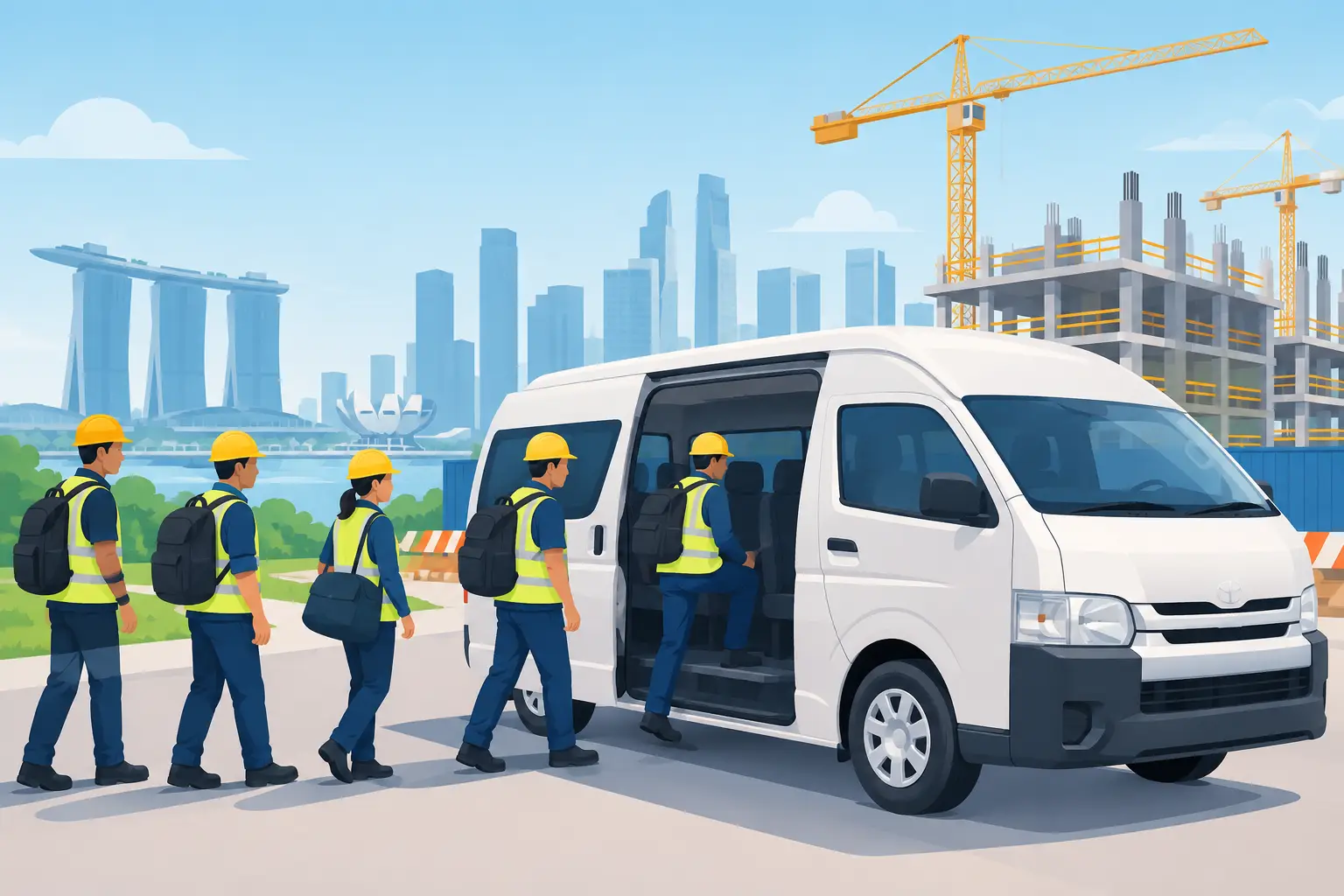
A late minibus does more than delay a few employees. It can hold up a production line, leave a site short-staffed at handover, or force supervisors to rearrange a full shift. For companies coordinating smaller teams across multiple pickup points, 13 seater staff transport Singapore services offer a practical middle ground: enough capacity for a work crew, without paying for unused bus seats.
The right arrangement is not simply about booking a vehicle that fits 13 people. It is about building a dependable daily movement plan around shift times, worksite access, employee comfort, and the realities of Singapore traffic.
When a 13-Seater Is the Right Fit
A 13-seater is often well suited to teams that travel together but do not need a large bus. This may include a construction work crew heading to an active site, a small factory shift traveling from a dormitory, office staff attending a corporate function, or technicians moving between a central meeting point and a customer location.
For recurring staff transport, the key advantage is right-sized capacity. A larger 23- or 40-seat bus may make sense when several teams share a route, but it can be unnecessarily costly when only a dozen people need transport. On the other hand, splitting 10 to 13 employees across several cars or ride-hailing bookings can make attendance harder to track and costs less predictable.
A 13-seat minibus keeps the team in one vehicle, gives the driver one clear route to manage, and helps staff arrive together. That matters particularly for early shifts, late-night releases, and locations where public transport is less convenient.
Capacity should still be confirmed before booking. Vehicle configurations vary, and a group carrying tool bags, safety equipment, bulky samples, or airport luggage may need more room than the seat count suggests. A transport provider should help assess both passenger numbers and what the group is bringing.
Planning 13 Seater Staff Transport Singapore Routes
The strongest staff transport plans are built around the working day, not just a pickup address and destination. A route that appears short on a map can become unreliable if it includes too many individual stops, congested expressway periods, or difficult entry procedures at a site.
Start with the shift reporting time. Work backward to set the arrival target, allowing time for security checks, site registration, walking from the drop-off point, and any pre-shift briefing. If employees must be ready at 7:00 a.m., arriving at the gate at 7:00 a.m. is usually too late. A planned buffer is far more useful than asking drivers to rush.
Next, group pickups sensibly. A single collection point near a dormitory, MRT station, or residential cluster is generally easier to run on time than multiple door-to-door pickups. Some businesses need several stops because employees live in different areas. In that case, the route should be arranged in geographic order and tested against actual morning or evening traffic conditions.
For sites with changing manpower needs, flexibility matters. A contractor may need 13 seats for one project phase, then require a larger vehicle when another team joins. A provider with 13-, 23-, and 40-seat options can adjust the arrangement without forcing the company to rebuild its transport plan from scratch.
Shift Work Requires Extra Attention
Shift-based operations have less room for error. Morning peak-hour trips need enough lead time, while night-shift transport requires a driver and vehicle schedule that remains dependable when public transit options are limited.
It also helps to agree on a clear no-show and late-arrival process. Supervisors should know whether the vehicle will wait, how long it can wait, and who has authority to communicate a route change. This avoids confusion that can affect every passenger after the first stop.
For round-the-clock sites, daily employee pickup and drop-off can be scheduled around each shift rather than treated as a collection of last-minute bookings. This gives operations teams a more stable plan and gives employees confidence that they can get to work safely and on time.
What to Confirm Before Booking
A good transport arrangement is specific. Before confirming a 13-seater, share the operational details that affect the journey rather than only the start and end locations.
- Number of passengers for each trip, including expected changes by day or shift
- Pickup points, required arrival time, and return or drop-off schedule
- Worksite access rules, loading bay instructions, and designated waiting areas
- Luggage, equipment, wheelchairs, or other items requiring additional space
- Whether the service is a one-time booking, hourly charter, or recurring contract
These details allow the transport provider to recommend a suitable vehicle and route. They also reduce the chance of operational surprises on the first day of service.
If your team changes frequently, appoint one onsite coordinator. The coordinator can provide passenger updates, contact the driver if a pickup point changes, and report recurring issues such as a stop that consistently causes delays. One clear contact person makes daily operations faster for everyone.
Safety, Comfort, and Professional Drivers
Staff transport is part of workplace operations, so safety should never be an afterthought. Licensed, insured vehicles and professional drivers are fundamental, especially when employees travel before dawn, after late shifts, or to industrial locations.
Comfort also has an operational value. Employees who travel in a clean, air-conditioned vehicle arrive in better condition than those who have had to manage multiple transfers in heavy rain or extreme heat. For organizations recruiting workers from different parts of Singapore, reliable transport can make a difficult commute more manageable.
Professional driving is more than knowing the fastest route. It includes safe pickup and drop-off habits, patience around site traffic, clear communication, and respect for passengers. At busy worksite gates, an experienced driver can follow access procedures without creating unnecessary hold-ups.
Singapore Workers Transport supports workforce movements with professionally driven vehicles for regular employee routes, one-time group transfers, and changing operational needs. The objective is straightforward: get people where they need to be safely, punctually, and at a cost that makes sense for the business.
Recurring Contracts vs. One-Time Bookings
A one-time 13-seater booking works well for a site inspection, company outing, training day, airport movement, or temporary project assignment. It provides a direct way to move a small group without coordinating separate cars.
Recurring transport is a better fit when the same team travels daily or on a fixed shift schedule. A regular arrangement allows the route, pickup timing, and passenger expectations to become familiar. It also gives managers a clearer view of transport spending instead of dealing with irregular claims and individual ride expenses.
The decision depends on how stable the requirement is. A project with a two-week mobilization may only need short-term scheduled service. A factory or construction site operating for months may benefit from a longer transport contract with agreed routes and timing. In both cases, communicate expected changes early. Adding passengers, changing the reporting time, or relocating a pickup point can affect the vehicle and route needed.
Avoid Common Staff Transport Problems
The most common issue is underestimating journey time. A route may be smooth at midday but slow considerably during morning peak hours or when rain affects traffic. Build in a practical buffer rather than planning every trip to the minute.
Another mistake is booking based only on the number of seats. If 13 people are carrying equipment, luggage, or large personal bags, a 13-seater may feel cramped or may not be the best operational choice. In some cases, moving to a larger vehicle delivers a more comfortable and reliable trip.
Finally, avoid unclear pickup instructions. Drivers need the correct gate, building name, contact person, and timing. Employees need to know where to wait and when the vehicle will depart. Simple communication prevents missed pickups and protects the schedule for the full group.
A well-planned 13-seater service turns staff travel from a daily uncertainty into a routine your team can rely on. Share your passenger count, shift schedule, pickup locations, and site requirements early, and the right vehicle plan can keep your workforce moving with less pressure on every workday.