




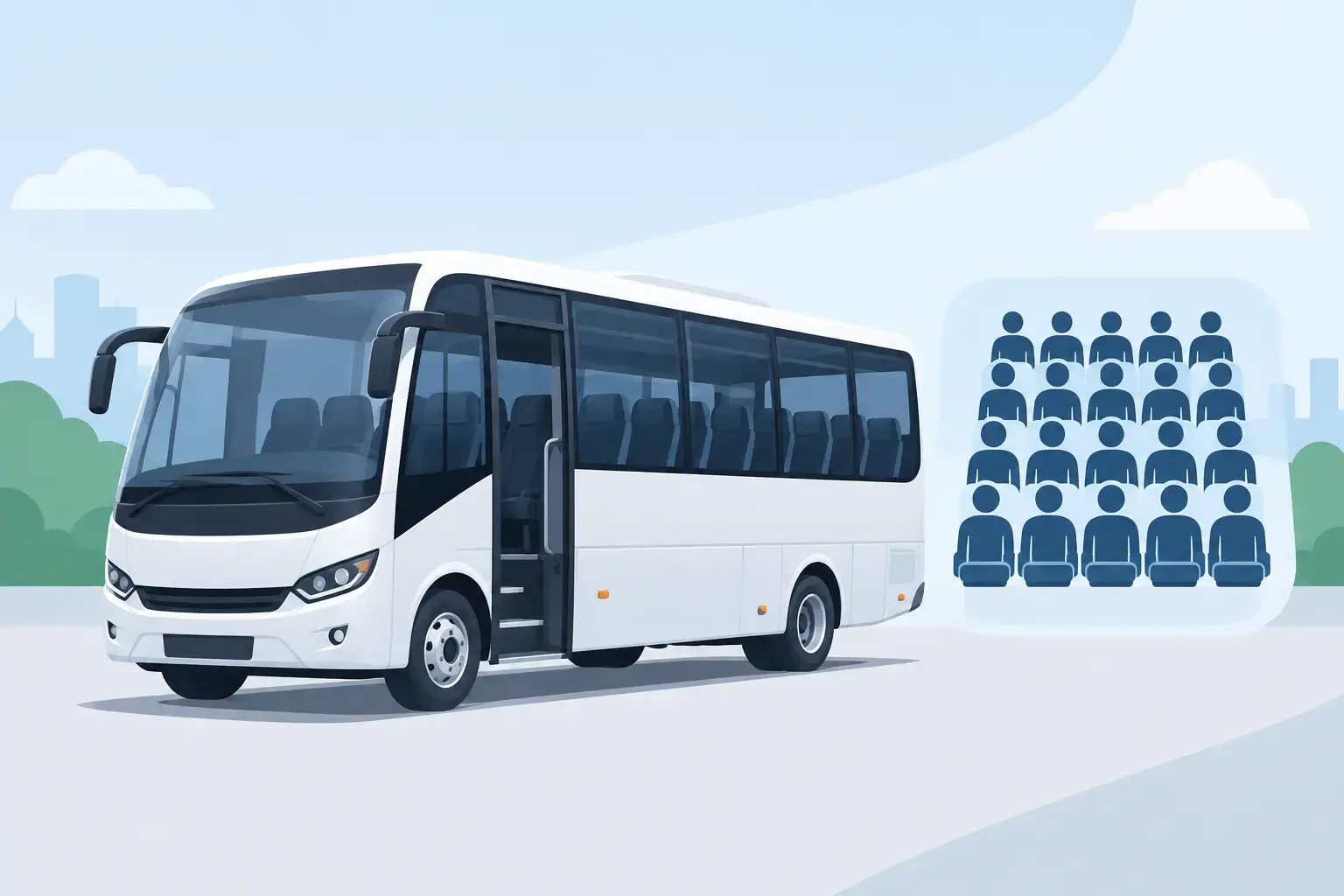
A 30-person headcount can look simple on paper, then become complicated at pickup time. Bags take seats, late additions appear, shift teams change, and a vehicle that is technically large enough may not be comfortable enough. If you are asking what bus fits 30 passengers, the most direct answer is a 30-seat or 33-seat bus. But the right booking depends on luggage, route length, passenger profile, and whether your group needs room to grow.
For daily staff transport, site transfers, airport movements, and corporate outings, choosing the correct vehicle capacity helps keep journeys safe, punctual, and affordable. Booking too small creates avoidable stress. Booking much larger than necessary can raise the cost without adding much practical value.
What bus fits 30 passengers?
A 30-seat bus is the natural fit for a group of 30 passengers traveling with little or no luggage. It gives every passenger a proper seat and keeps the group together in one vehicle. This is often the best choice for employee shuttle routes, short point-to-point transfers, worksite travel, training sessions, and event movements where the passenger count is stable.
In real operations, however, a 40-seat bus is often the smarter choice when 30 passengers are carrying suitcases, equipment, cartons, safety gear, or personal belongings. The extra seats create breathing room and provide a buffer if a supervisor, visitor, or replacement worker needs to travel at short notice.
A 23-seat minibus is not suitable for 30 passengers. Splitting the group between two vehicles is possible, but it requires tighter coordination, two drivers, and a clear plan for keeping both vehicles on schedule. For a recurring workforce route, one correctly sized bus is usually easier to manage.
Choose capacity based on the journey, not only the headcount
The passenger number is the starting point, not the final answer. A bus seating 30 people can work very differently depending on where the group is going and what they bring along.
Daily staff shuttle and worker transport
For a routine pickup and drop-off service, a 30-seat bus is typically efficient when ridership remains close to 30 every day. It is particularly suitable for office teams, factory workers, dormitory-to-site transfers, and staff traveling between MRT stations and workplaces.
Before confirming the vehicle, consider attendance patterns. If the route regularly carries 28 to 30 employees but rises to 32 on certain shifts, a 40-seat bus prevents the daily question of who needs alternative transport. This flexibility is valuable for construction projects, new site mobilizations, and teams with rotating manpower.
Route planning matters as much as seat count. A bus with multiple pickup points needs adequate time for boarding, traffic delays, and safe passenger movement. A professional driver and a fixed route plan help ensure workers arrive ready for their shift rather than late and rushed.
Airport transfers and trips with luggage
For 30 passengers going to or from the airport, a standard 30-seat bus may be too tight if everyone has full-sized luggage. The seating capacity may be correct, but luggage storage is the deciding factor.
A 40-seat bus, a bus with dedicated baggage space, or a combination of a bus and luggage vehicle may be better. The same applies to company retreats, hotel transfers, overseas travel, school excursions, and group tours. Ask about baggage capacity before booking, and describe the expected number of large suitcases, cabin bags, strollers, sports equipment, or boxed items.
Trying to place bags in aisles or on seats is not a good transport plan. It reduces passenger comfort and can create safety issues during braking or turns.
Events, meetings, and short group transfers
A 30-seat bus is a practical option for corporate events, seminars, team-building activities, weddings, and venue transfers. These trips usually involve lighter bags and a defined passenger list, making capacity easier to predict.
If your event ends late or has several departure waves, consider whether one larger bus can make multiple scheduled runs. This can be more cost-effective than booking additional vehicles that sit idle between trips. The right arrangement depends on the venue, event schedule, and how long passengers are willing to wait.
30-seat bus vs. 40-seat bus
The decision between a 30-seat and 40-seat bus comes down to efficiency versus flexibility. Neither is automatically better.
A 30-seat bus is often the more economical choice for a confirmed group of 30 with minimal belongings. It keeps the vehicle size aligned with the job and is easier to justify for regular transport budgets. It is a strong fit when the route, staffing level, and pickup schedule are consistent.
A 40-seat bus gives your operation a useful capacity margin. It is better for mixed teams, changing attendance, luggage-heavy trips, and routes where a few additional passengers may join. It can also feel less crowded on longer journeys, especially for staff traveling after physically demanding shifts.
The trade-off is that a larger bus may cost more and may be less convenient at locations with narrow access roads, limited loading zones, or tight turning areas. For industrial sites and older buildings, confirm the pickup point and vehicle access before committing to a larger bus.
When two smaller vehicles make more sense
One bus is not always the best operational answer. Two smaller vehicles can be more effective when your group starts from different areas, works different shift times, or needs separate drop-off points.
For example, 30 employees may be traveling to the same project, but 15 are coming from the west and 15 from the east. Two minibuses can reduce pickup time and prevent a long cross-island detour. The same approach can help when one group carries tools or equipment while another group travels with only personal items.
This option does require good coordination. You need clear passenger lists, assigned vehicle groups, driver contact details, and a plan for delays. If the goal is simply moving all 30 people from one place to another at the same time, a single bus is usually simpler.
Details to confirm before booking a 30-passenger bus
A reliable transport provider should ask practical questions, not only take a passenger number. Share the date, pickup time, pickup and destination addresses, number of passengers, luggage estimate, and any special needs such as wheelchairs, bicycles, pets, oversized items, or multiple stops.
For recurring staff transport, provide shift timings and expected headcount changes. This allows the route to be planned around actual operations rather than a generic timetable. A five-minute delay at one pickup can become a larger issue by the time the bus reaches a factory, office, or worksite.
Also clarify whether the bus is needed for a one-way transfer, a round trip, or hourly charter. A vehicle waiting on site between trips may be the right choice for an event, while a fixed point-to-point arrangement may be more suitable for a daily employee commute.
A practical capacity rule for 30 passengers
Use a 30-seat bus when all 30 passengers are confirmed, luggage is light, and the route is straightforward. Choose a 40-seat bus when you expect luggage, fluctuating attendance, longer travel, or extra riders. Consider two smaller vehicles when pickup areas or schedules are genuinely different.
Singapore Workers Transport can help match the vehicle and route to daily workforce movements, corporate transfers, airport groups, and special trips. The most useful booking request includes more than a headcount: explain how your group travels, what they carry, and what time they must arrive. That is how a bus becomes a dependable part of your operation, not just a ride from one location to another.