




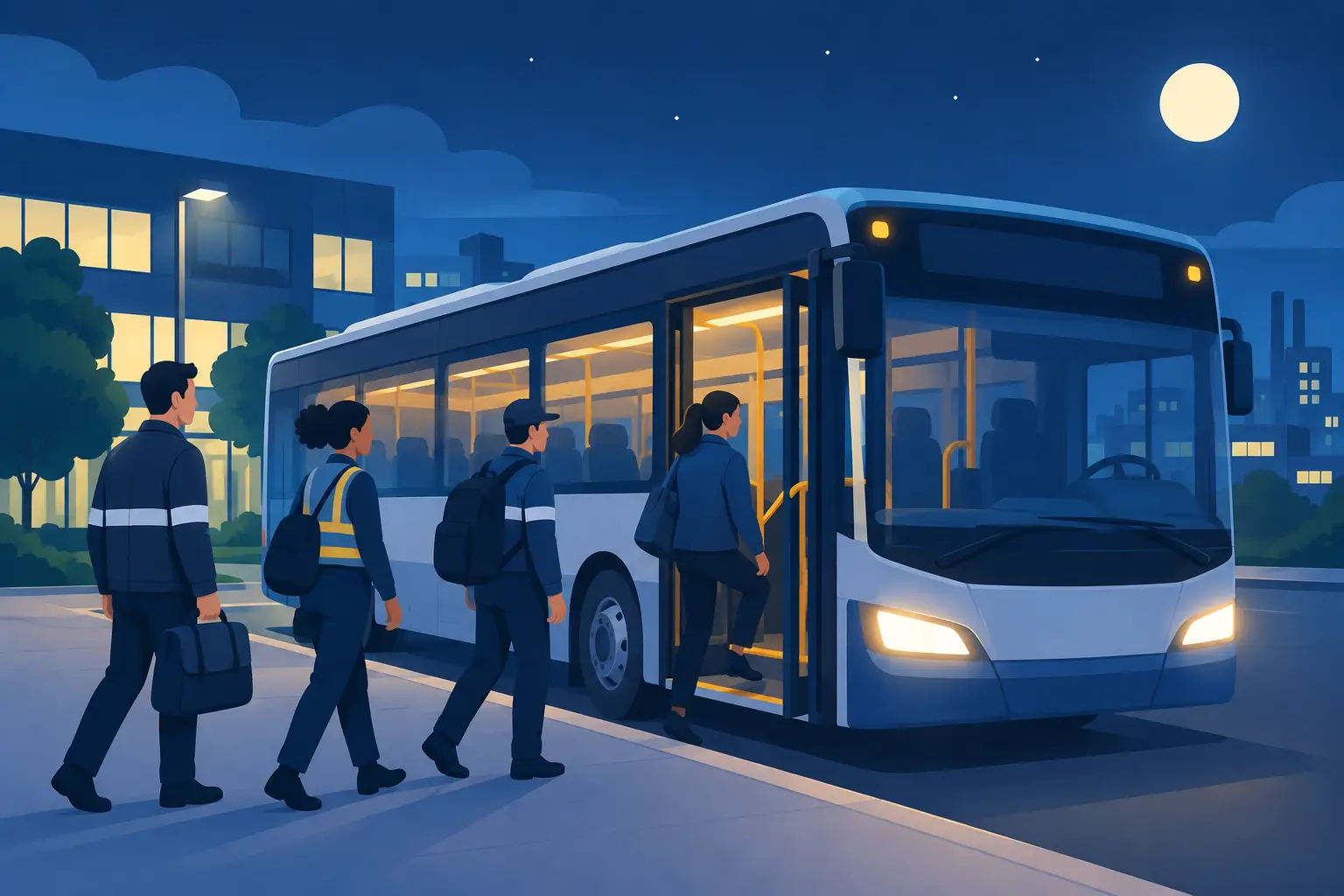
A 7:00 p.m. shift change can be straightforward. A 7:00 a.m. release is often where the real transport problem begins. Public transit may be less frequent, workers may be tired, and a late arrival can leave a production line, security post, or construction activity short-staffed. So, can buses serve night shifts? Yes, provided the service is planned around the actual operating schedule rather than treated as a standard daytime shuttle.
For businesses in Singapore that run overnight operations, dedicated staff buses give workers a dependable way to reach sites and return home safely. The value is not simply putting a vehicle on the road after midnight. It is building a route, vehicle plan, and communication process that supports attendance, safety, and cost control shift after shift.
Why night-shift transport needs a different plan
Night operations have less room for transport errors. A bus that arrives 15 minutes late at a daytime office may cause frustration. A late pickup for a night crew can delay a handover between teams, leave equipment unattended, or force supervisors to find last-minute replacements.
The travel pattern is different, too. Employees may start from residential areas, dormitories, MRT stations, or designated pickup points. Some work sites are in industrial areas where public transport options become limited late at night or early in the morning. A well-managed night-shift bus service accounts for those gaps instead of assuming every employee can make their own way to work.
Fatigue is another practical concern. Workers finishing a long shift should not have to wait alone for uncertain transport or drive home when they are exhausted. A scheduled bus gives them a clear departure time, a known pickup location, and a professional driver responsible for the journey.
The business impact goes beyond getting people to work
Reliable transport supports punctual reporting, but it can also improve retention. Employees are more likely to stay with an employer when their commute is manageable, especially when they work hours that are inconvenient for family life and normal public transport schedules.
For operations managers, the benefit is predictability. Instead of responding to individual transportation issues every morning, they can work from a confirmed route plan. HR teams can use the service as a practical staff benefit. Site supervisors can focus on shift readiness rather than chasing late arrivals.
Can buses serve night shifts across multiple locations?
They can, but route design matters. A single direct route works well when most workers live in the same area or report to one site. Businesses with staff spread across several zones may need multiple pickup points, staggered vehicle departures, or separate services for different sites.
The best setup depends on headcount, shift timing, and the distance between stops. A 13-seat minibus may be a sensible choice for a small technical crew or security team. A 23-seat bus can suit a department-sized group. For larger factories, construction projects, warehouses, or dormitory movements, a 40-seat bus may provide better cost efficiency per passenger.
Capacity should not be decided on headcount alone. Consider whether the route has enough room for different pickup times, whether workers carry equipment or bags, and whether there are peak days with higher attendance. Booking a vehicle that is consistently too small creates avoidable delays. Booking one that is far too large can raise transport costs without adding operational value.
For teams working split shifts, it may be more practical to schedule separate inbound and outbound services. One bus can bring the incoming crew to the site before shift start, while another returns the outgoing crew home after handover. This avoids asking employees to wait through a changeover period and keeps the transition orderly.
What a dependable night-shift bus schedule should include
A night-shift transport plan should begin with shift start and end times, then work backward. If employees must report by 8:00 p.m., the final pickup should allow enough buffer for traffic, passenger boarding, security checks, and site access. Do not schedule arrival at the exact moment work begins.
The same principle applies after shift end. Workers should know whether the bus departs immediately after handover or after a fixed waiting period. A clearly stated departure window reduces confusion, particularly when different teams finish tasks at slightly different times.
A workable plan normally includes these operating details:
- Fixed pickup points that are safe, easy to identify, and practical for buses to access.
- A passenger list or expected headcount for each route and shift.
- A clear contact person for attendance changes, site delays, or urgent route issues.
- A buffer between scheduled arrival and the start of work.
- A backup approach for breakdowns, sudden overtime, or unusually high passenger numbers.
These details may sound basic, but they prevent the common failures that make staff transport feel unreliable. A route can look efficient on paper and still fail if the pickup point is poorly chosen, the driver does not have updated instructions, or employees receive no notice when a departure time changes.
Build in flexibility for overtime and shift extensions
Night work does not always end on time. Production issues, deliveries, safety checks, equipment faults, and weather delays can extend a shift. If overtime happens regularly, a fixed bus departure may leave some staff stranded or require supervisors to arrange expensive ad hoc rides.
There are several ways to handle this. A business may set a standard overtime departure time, arrange an additional vehicle on known peak days, or establish an hourly booking option for exceptional situations. The right choice depends on how often schedules change. Paying for a standby vehicle every night may not make sense for occasional overtime, while ad hoc transport may become costly if delays are routine.
Communication is essential. Supervisors should have a direct way to report delays early, and employees should know who will confirm revised pickup arrangements. Quick coordination is particularly important for overnight services, when alternatives may be limited.
Safety and comfort are part of operational reliability
A night bus service should be safe from the moment an employee reaches the pickup point. Companies should select locations with adequate lighting and reasonable waiting conditions where possible. Pickup instructions should be simple enough that a new employee, temporary worker, or visitor can follow them without confusion.
Vehicles also need to match the journey. Air-conditioning, clean seating, sufficient space, and regular maintenance make a difference for workers traveling at the end of a demanding shift. Comfort is not an extra when employees are expected to rest before another workday. It helps make the commute sustainable.
Professional drivers are equally important. They need to understand the route, site access requirements, passenger handling expectations, and the importance of punctual departures. Licensed, insured vehicles and experienced drivers provide reassurance to both the business and its employees.
For higher-level personnel, visiting managers, or executive teams working late, a premium MPV can be more suitable than a standard staff bus. The vehicle choice should reflect the number of passengers, luggage needs, journey length, and required level of comfort. A mixed fleet gives businesses flexibility without forcing every trip into the same format.
Managing cost without sacrificing service
Night transport is often viewed as an added cost, but it should be measured against the cost of poor attendance, turnover, delayed handovers, unsafe journeys, and last-minute ride arrangements. A recurring contract with fixed routes can make budgeting easier than paying for individual trips whenever a transport problem occurs.
To control costs, review passenger numbers regularly. A route that was right when a project began may not remain right after staffing changes. Consolidating low-use stops, adjusting vehicle size, or changing departure times can improve efficiency. At the same time, do not cut stops so aggressively that the commute becomes unreasonable and employees stop using the service.
Transparent pricing and a clear service scope help avoid surprises. Before confirming a night-shift arrangement, establish the operating days, service hours, number of trips, vehicle capacity, waiting-time rules, overtime arrangements, and contact procedures. This gives both the employer and transport provider a shared operating standard.
Singapore Workers Transport can arrange customized staff transport routes for recurring day and night operations, with minibuses and buses sized for different workforce movements. The objective is simple: workers arrive safely and on time, while managers have one less daily logistics issue to manage.
Start with the shift, not the vehicle
The most effective night-shift transport service starts by mapping the workforce: where employees are coming from, when they need to arrive, when they can leave, and what happens when the shift changes. From there, the vehicle and route become much easier to choose.
A bus can serve night shifts very well when it is treated as part of the operation, not an afterthought. Give the schedule enough buffer, keep communication direct, and review the route as staffing needs change. That approach turns a late-night commute into a dependable part of the working day.