


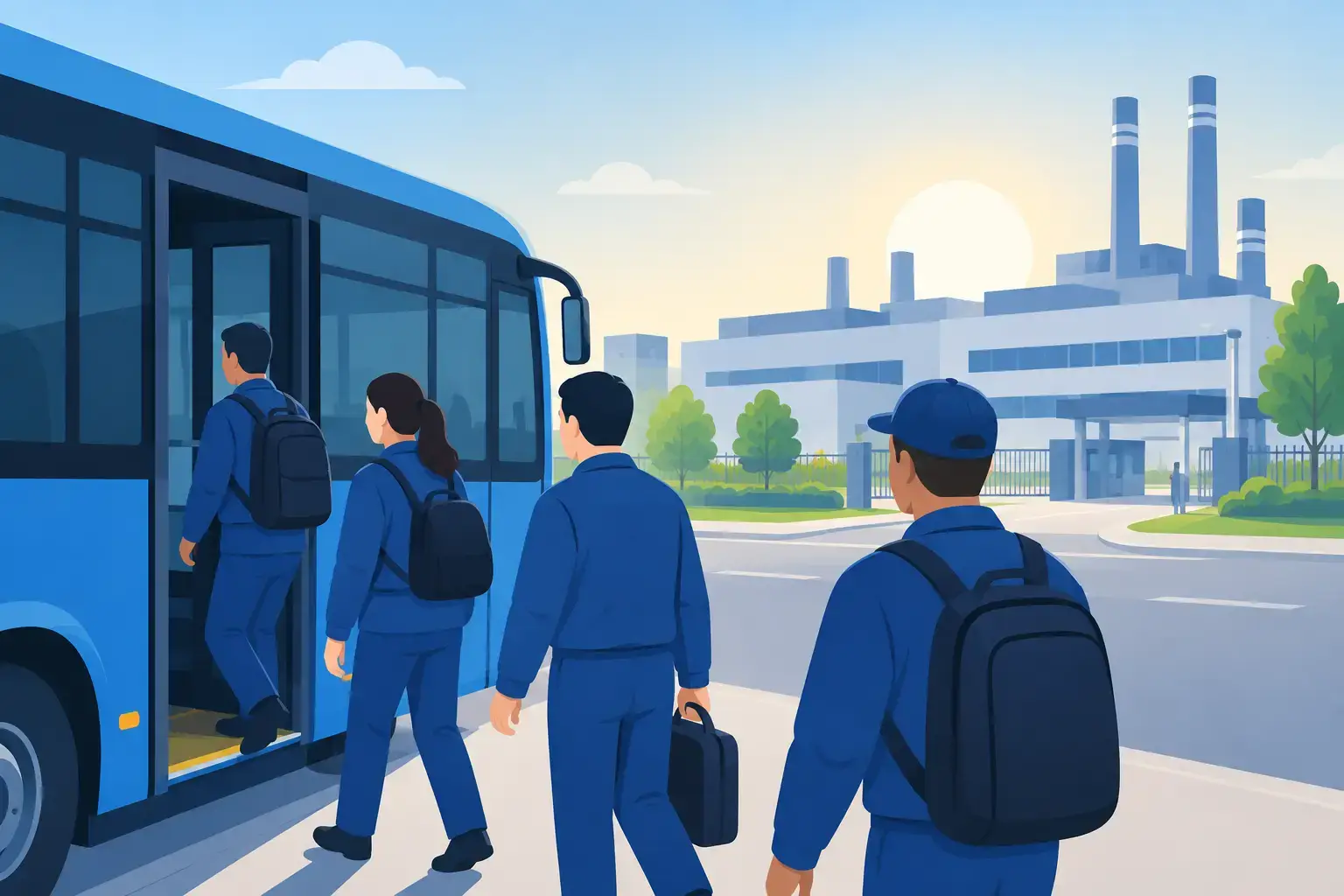
A 7:30 a.m. production shift can lose its rhythm before the first machine starts if 20 workers arrive in small groups between 7:25 and 7:50. A well-planned factory commute example shows how a dedicated staff bus route turns scattered arrivals into a predictable, safe, and punctual start to the workday.
For factory operators, construction contractors, and site managers in Singapore, employee transport is not simply a staff benefit. It is an operational control. The right route reduces late clock-ins, helps supervisors plan manpower accurately, and gives workers a dependable way to reach industrial areas, remote sites, and early shifts.
A Factory Commute Example for a 120-Worker Site
Consider a factory in Tuas operating two daily shifts. The morning shift begins at 7:30 a.m., while the evening shift begins at 7:30 p.m. The site has 120 employees per shift, with most workers living across Jurong West, Bukit Batok, Woodlands, and nearby dormitories.
Before arranging dedicated transport, workers use a mix of public buses, MRT connections, ride-hailing, and private motorcycles. This works for some employees, but the final connection to the factory is inconsistent, especially for workers starting before peak public transport service or finishing late at night. Supervisors regularly manage late arrivals, while workers face long, tiring commutes before physically demanding shifts.
A practical solution is to organize three recurring pick-up routes using 40-seat buses. Each vehicle carries up to 40 passengers, allowing the company to move the full 120-person shift without overcrowding or unnecessary extra trips.
Route A starts in Jurong West, collects 38 employees at two agreed pick-up points, and travels directly to the factory. Route B serves Bukit Batok and a nearby MRT meeting point, carrying 39 employees. Route C begins at a Woodlands dormitory, then makes one scheduled stop in the western industrial area for 36 workers. The remaining seats give the transport coordinator some flexibility for new hires, temporary staff, or workers assigned to a different collection point.
The buses are scheduled to reach the factory by 7:05 a.m. This gives employees time to enter the site, change into required PPE, attend safety briefings, and be ready for a 7:30 a.m. start. The return trips leave at 7:45 p.m., after shift handover is complete, rather than forcing workers to wait too long after a demanding day.
Why the Route Design Matters
A staff bus is only reliable when the route is built around actual employee travel patterns. The shortest route on a map is not always the best route in practice. A route with too many stops may look convenient for individuals, but it can add 20 or 30 minutes to every journey and create more opportunities for delay.
In this factory commute example, each bus has no more than two or three collection points. Pick-up locations are chosen near residential clusters, dormitories, or transport interchanges where workers can gather safely. This keeps the route easy to understand and reduces the time spent driving through smaller roads for individual home pick-ups.
Timing also needs a buffer. If a bus must arrive at the factory at 7:30 a.m., one minor traffic issue can affect the entire production line. Planning for arrival 20 to 30 minutes before shift start creates a practical margin without requiring workers to leave home excessively early.
For operations with rotating shifts, the same route should not automatically be copied across every time slot. Morning traffic, afternoon school traffic, and late-night road conditions can differ. A 6:00 a.m. departure may need one schedule, while a 6:00 p.m. departure may need another. Reviewing actual journey times during the first few weeks helps the transport arrangement stay punctual.
Choosing the Right Vehicle Capacity
Vehicle size affects both cost control and employee comfort. Sending a 40-seat bus with 18 passengers may be necessary for a remote route, but it can be inefficient if the same group can comfortably use a 23-seat minibus. On the other hand, booking a vehicle with too few seats creates avoidable crowding and leaves no room for occasional additional passengers.
For recurring workforce transport, common choices include 13-seat minibuses for smaller teams, 23-seat buses for medium-sized groups, and 40-seat buses for larger shift movements. The right option depends on the number of regular passengers, the amount of spare capacity required, and whether workers carry bags, safety gear, or equipment.
A site with 55 workers on one route may be better served by a 40-seat bus and a 23-seat bus rather than two 40-seat buses. If attendance often varies because of rotating off days, annual leave, or subcontractor schedules, a slightly larger vehicle can prevent last-minute transport problems. There is no single perfect ratio. The goal is to balance reliable seating with sensible operating cost.
Setting Clear Pick-Up Rules
The most dependable transport plan can still fail when passengers are unclear about where to wait or when the vehicle leaves. Every recurring route should have a simple written schedule stating the pick-up point, reporting time, bus identification, site destination, and return departure time.
Workers should be asked to arrive at the collection point five to 10 minutes early. The driver can wait briefly for safety and fairness, but a daily route cannot remain on hold for one late passenger. When this rule is communicated clearly from the beginning, workers understand that the bus schedule protects everyone’s arrival time.
A designated transport coordinator is also useful. This person can update passenger lists, manage new staff assignments, share schedule changes, and contact the transport provider when a shift pattern changes. For a large site, supervisors may nominate one representative per route so that questions and attendance updates are handled quickly.
Building Safety Into the Daily Commute
Factory transport should feel routine, but it should never be treated casually. Licensed, insured vehicles and professional drivers matter because the journey happens every day, often during early hours, late nights, or heavy rain. Vehicles should have appropriate seating, functioning air conditioning, and sufficient space for passengers to board and exit safely.
The route itself should consider more than travel time. A pick-up point beside a busy road without a safe waiting area may create unnecessary risk. A slightly longer route that uses a sheltered, well-lit gathering point can be the better decision, particularly for night-shift workers.
For factories that require PPE or access passes, managers can also use the journey time constructively. Brief safety reminders, shift notices, or site updates can be shared before arrival. This should not become a substitute for formal safety training, but it can help employees arrive prepared and informed.
Measuring Whether the Arrangement Works
A staff transport contract should be reviewed like any other operational service. Track actual arrival times, passenger numbers, late incidents, vehicle utilization, and worker feedback. If Route B regularly reaches the site 25 minutes early while Route C arrives with only a five-minute buffer, the schedule needs adjustment.
The first month is often the most valuable testing period. Employee addresses may change, a new dormitory may open, or headcount may rise on one shift. A transport provider that can customize recurring routes and respond quickly to changes helps managers avoid long-term inefficiencies.
Cost should be reviewed alongside reliability. The lowest quoted rate is not always the lowest total cost if workers arrive late, supervisors spend time arranging backup rides, or production teams begin short-handed. A dependable daily service provides value through attendance stability, not just through the price of the vehicle.
Singapore Workers Transport can support recurring factory pick-up and drop-off arrangements with 13-, 23-, and 40-seat vehicles, planned around shift times, worker locations, and site requirements. For occasional overtime, training sessions, or additional manpower movements, the same transport plan can be expanded with suitable vehicles when needed.
A good commute arrangement gives workers a calmer start and gives site managers one less uncertainty to manage. When buses arrive at the right place, at the right time, every shift begins with people ready to work.