


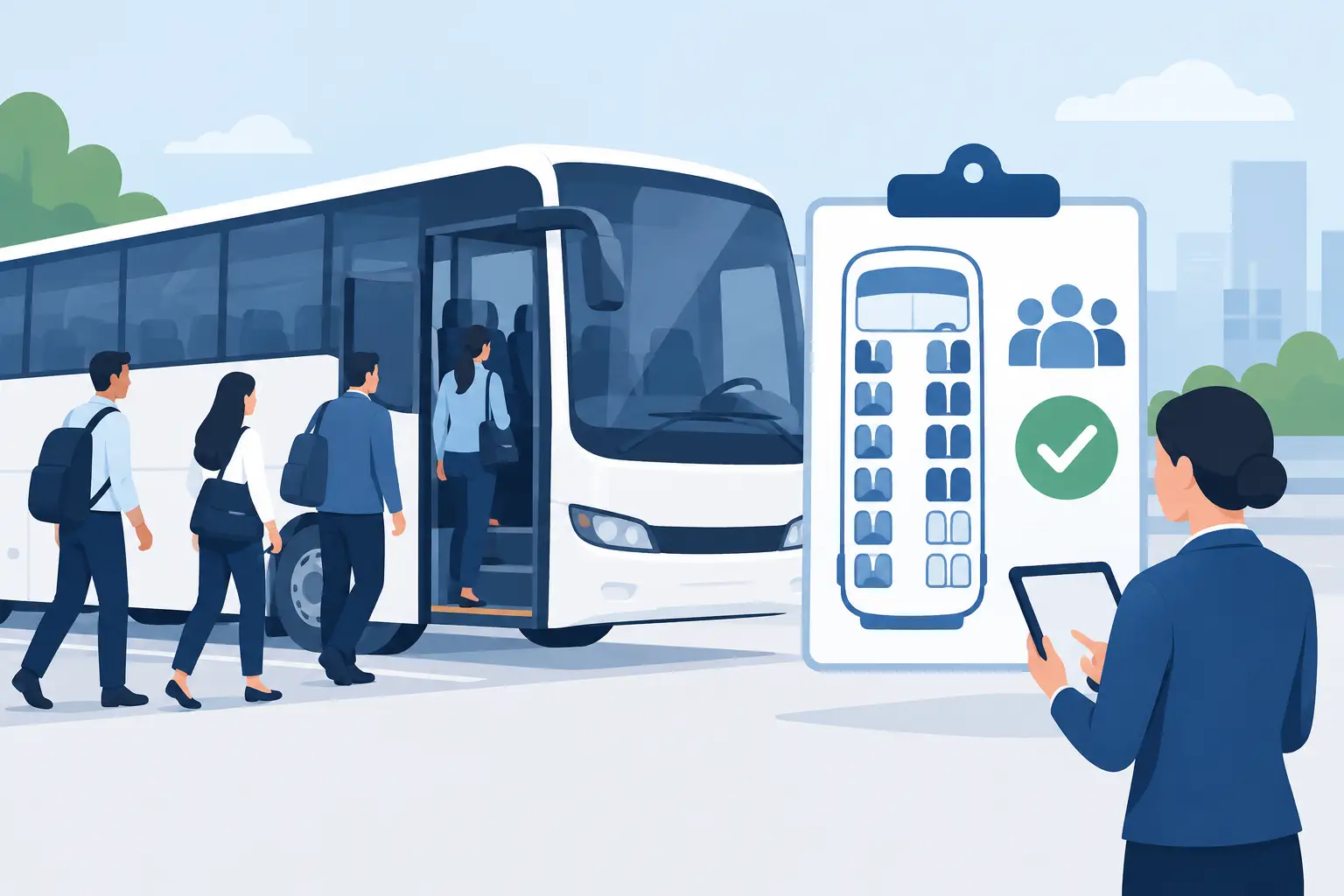
A 40-seat bus is not automatically the right answer for 40 employees. If every seat is filled, one late worker, one passenger with bulky equipment, or one last-minute route change can disrupt the entire shift. For operations teams, knowing how to calculate bus capacity means planning for actual daily movement, not simply matching headcount to the number printed on a vehicle listing.
The goal is to get employees to site safely, punctually, and at a controlled cost. That requires a clear view of passenger numbers by shift, pickup locations, travel time, luggage or equipment needs, and the flexibility your operation needs when attendance changes.
Start With the Licensed Seat Count
The first number is the vehicle’s licensed passenger capacity. This is the maximum number of passengers the vehicle is approved to carry, excluding the driver unless the operator states otherwise. A 13-seat minibus generally carries up to 13 passengers, while a 23-seat or 40-seat bus is designed for larger groups.
This number is a legal and safety limit, not a target to exceed. Every passenger needs a proper seat, and the vehicle must never be overloaded because a route is busy or a group has grown unexpectedly. Confirm the stated seating layout with your transport provider, particularly if your team includes passengers who need extra space or accessibility support.
For simple one-time transfers, the calculation may be as direct as this:
Required seats = total passengers + required spare seats
If 20 people are traveling together and you want two spare seats for comfort and contingencies, book at least 22 seats. A 23-seat bus is the practical match.
For recurring worker transport, however, capacity planning needs more than a single headcount.
How to Calculate Bus Capacity by Shift
Businesses with factories, worksites, offices, and dormitories should calculate demand separately for each pickup and drop-off window. Do not combine all employees into one total if they start at different times or travel from different areas.
Begin with the number of passengers expected on each run. Then add a planning buffer based on how stable attendance is. A fixed office team with predictable schedules may need only a small buffer. A construction site with rotating subcontractors, overtime, or frequent replacement workers may need more room.
Use this practical formula:
Bus seats needed = expected riders per run x occupancy allowance + contingency seats
For example, assume 34 workers need transport for a 7:30 a.m. shift. You want to avoid operating at full capacity, so you plan around 90% occupancy. Divide 34 by 0.90, which gives 37.8. Round up to 38 seats, then consider one or two contingency seats if attendance often changes. A 40-seat bus is the sensible choice.
Planning for 85% to 90% occupancy often gives operations managers a useful balance. It avoids paying for a much larger vehicle than needed while leaving enough capacity for an additional rider, temporary staff member, or small change in route demand.
The right percentage depends on the service. For a one-off event where every attendee has confirmed, a full vehicle can be reasonable. For daily staff shuttle service, some spare capacity usually improves reliability and employee comfort.
Separate Peak Demand From Average Demand
Average daily ridership can be misleading. A route may average 20 passengers across a month but carry 28 people every Monday, during project mobilization, or when a night shift overlaps with a day shift. Vehicles must be selected for the peak run, not the quietest day.
Review attendance records, rosters, and access logs over several weeks if they are available. Identify the highest recurring demand by route and shift. Also ask site supervisors about upcoming changes, such as a new work area, additional labor, training sessions, or a revised reporting time.
If a 23-seat bus is full only once or twice a month, a second vehicle may be arranged for those dates. If it is full three or four days each week, moving to a larger bus or splitting the route is likely the more dependable option.
Account for Route Design, Not Just Seats
A bus can have enough seats and still be the wrong solution if the route is poorly designed. Every additional pickup stop adds travel time, creates more opportunities for delay, and may cause employees to spend too long on the road before work.
When calculating capacity, map each pickup cluster and estimate how many riders board at each point. A route with 38 riders across two dormitories may work well with one 40-seat bus. The same 38 riders spread over eight scattered locations may require two smaller vehicles or separate route loops to protect punctuality.
Consider these operating questions while planning:
- Can all passengers board within a reasonable time at each stop?
- Will the route reach the worksite before the reporting deadline, including normal traffic conditions?
- Does the return trip need the same capacity, or do overtime and staggered finishes change the demand?
- Are there narrow roads, loading restrictions, or site access points that limit the vehicle size?
A smaller vehicle may cost less per trip, but it can become more expensive if it needs multiple runs or creates late arrivals. Conversely, a larger bus with too many unused seats may not be the most cost-effective daily arrangement. The best plan considers cost per transported employee, not only the price of one vehicle.
Include Luggage, Equipment, and Personal Space
Passenger seats are only one part of usable bus capacity. Airport transfers, cross-border trips, tours, and project movements often involve luggage, tool bags, safety gear, cartons, or equipment. A vehicle that seats 13 passengers may not comfortably carry 13 large suitcases at the same time.
Ask two separate questions: how many people are traveling, and what are they bringing? For airport groups, count large checked bags, cabin bags, strollers, foldable wheelchairs, or oversized items. For workforce transport, consider personal protective equipment, lunch bags, tools, and any site-issued materials that employees carry daily.
This is especially relevant for minivans and premium MPVs. A 6- or 7-seat vehicle may be ideal for an executive airport transfer with light luggage, while a larger van or minibus is more practical for the same number of travelers carrying full-size suitcases. Comfort matters too. A full vehicle can be acceptable for a short city transfer, but a longer journey may call for extra room.
Choose the Right Vehicle Mix
A single large bus is not always the most efficient answer. If your demand is split across different areas or shift times, a mixed fleet can provide better coverage. For example, a 40-seat bus may serve the main dormitory route, while a 13-seat minibus picks up a smaller group near another industrial area.
For general planning, these categories are useful:
| Vehicle type | Typical planning use | |—|—| | 6- to 7-seat MPV | Small executive teams, airport transfers, family groups | | 9- to 13-seat van or minibus | Small staff teams, site visits, compact group transfers | | 23-seat bus | Medium workforce routes, event groups, single-shift movements | | 40-seat bus | Larger staff populations, dormitory routes, high-demand shift transport |
Vehicle selection should also reflect the service frequency. Two 23-seat buses can offer route flexibility and a backup option, but they require two drivers and may cost more than one 40-seat bus. One 40-seat bus may simplify dispatch, but it is less flexible if passengers are distributed across distant pickup points.
Build in Capacity for Changes
Transport plans often fail because they are designed around a static roster. Staffing levels change. New hires join, contractors rotate, teams work overtime, and a new project phase can shift demand within days.
Set a review point for recurring transport contracts, such as every month or whenever staffing changes by more than 10%. Track actual riders, no-shows, late arrivals, and instances where a vehicle reached full capacity. These records make it easier to adjust before employees are left behind or a route becomes unreliable.
It also helps to agree on escalation procedures with your provider. If 10 additional workers are assigned to a site next week, determine whether the current route can be upgraded, whether a second vehicle can be added, and how much notice is needed. Singapore Workers Transport supports customized recurring routes, which helps businesses adjust vehicle capacity as workforce needs change.
A Practical Capacity Example
Imagine a company needs transport for 68 employees traveling to a worksite at 7:00 a.m. Forty-six employees live near one dormitory cluster, while 22 live near another. Attendance fluctuates by a few people each day, and some workers carry small equipment bags.
For the first cluster, a 40-seat bus will not be enough on its own. The company could use one 40-seat bus and one 13-seat minibus, giving 53 seats and a reasonable buffer. For the second cluster, a 23-seat bus gives one spare seat while avoiding an overfull vehicle.
That arrangement provides 76 total seats for 68 riders. It is not the only answer, but it protects punctuality, accommodates variable attendance, and avoids forcing one bus to make a second run. The better choice may change if the two clusters can be combined without extending travel time too much.
Capacity planning works best when it is treated as part of daily operations, not a one-time booking decision. Leave enough room for the people, bags, schedules, and unexpected changes that come with real workdays, and your transport service will be far more likely to arrive ready when the shift begins.