


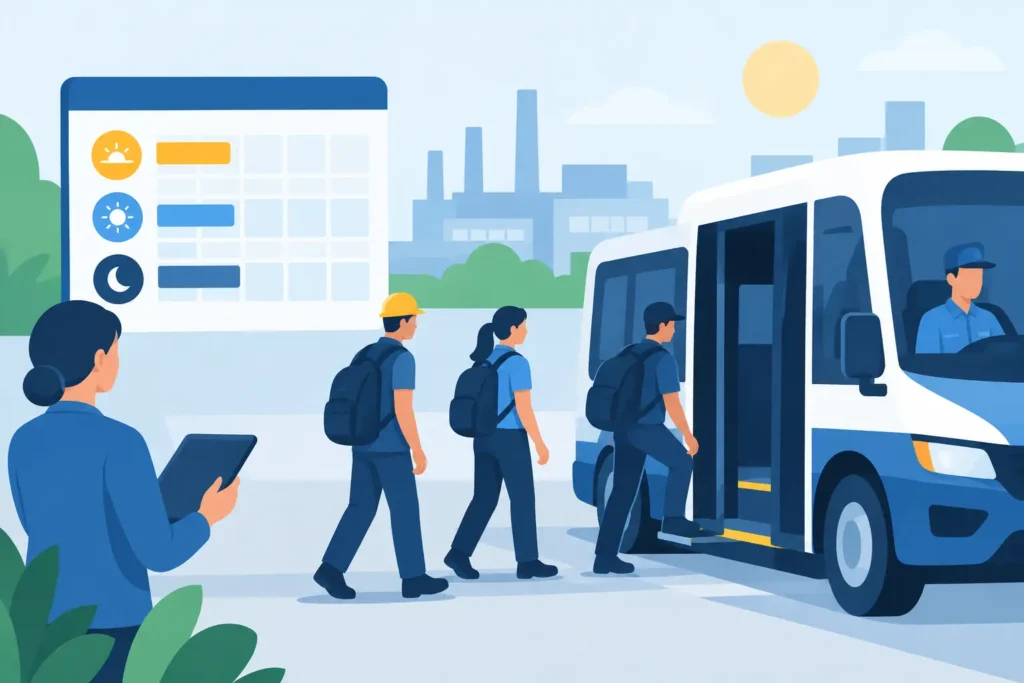
A missed worker pickup can delay an entire production line, leave a construction crew short-handed, or create an avoidable safety issue after a late shift. Knowing how to plan worker pickups means treating transport as part of daily operations, not a last-minute arrangement. The strongest plans match employee locations, shift times, vehicle capacity, and site access rules into a schedule people can rely on.
Start With the Worksite, Not the Vehicle
The first question is not whether you need a minibus or a larger bus. Start with the worksite’s operating requirements. Confirm exactly when workers must be on site, when they can leave, and whether attendance happens before the shift begins. If a factory shift starts at 8:00 a.m. but workers need to change, collect safety equipment, and report by 7:45 a.m., your planned arrival time should reflect that reality.
Construction sites and industrial facilities may have specific entry windows, security checks, loading zones, or restrictions on where vehicles can wait. Office locations can have their own challenges, including peak-hour traffic, limited curb space, and building management rules. A pickup plan that looks efficient on a map may fail if the driver cannot safely stop at either end of the journey.
Set a clear service standard before routes are built. For example, workers may be scheduled to arrive 15 to 20 minutes before shift start, while outbound transport may leave 10 minutes after the final worker is released. This small buffer protects the operation when traffic, rain, or access delays occur.
Build Pickup Routes Around Real Employee Locations
Ask employees for their pickup area, preferred stop, work shift, and any special travel needs. Use actual home clusters or convenient neighborhood meeting points rather than creating a long list of individual door-to-door stops. In a dense city such as Singapore, a well-chosen meeting point near a transit station, housing block, or safe roadside pickup area can save significant time every day.
Group workers by direction of travel first, then by shift. A route should move steadily toward the worksite. Avoid routes that double back across the same area simply to collect one or two additional passengers. That may raise the number of workers on board, but it can also make the ride too long and reduce punctuality for everyone else.
When deciding between door-to-door pickups and centralized stops, consider the trade-off. Door-to-door service can be helpful for senior staff, workers with mobility requirements, or locations without safe meeting areas. Centralized stops usually offer better time control and lower operating costs for larger teams. Many businesses use a combination: fixed neighborhood stops for most employees, with a tailored pickup arrangement for specific needs.
Keep the First Route Simple
For a new contract or a new worksite, begin with a straightforward route rather than trying to optimize every minute immediately. Run it for one or two weeks, review actual pickup times, then adjust stop order or departure time based on real conditions. Traffic patterns, worker punctuality, and site access often look different in practice than they do in a spreadsheet.
Match Vehicle Size to Headcount and Shift Patterns
Vehicle capacity affects both comfort and cost. A 13-seat minibus may suit a small site team or a focused neighborhood route. A 23-seat bus can work well for medium-sized shift groups, while a 40-seat bus is often more economical for larger factory, dormitory, or construction workforce movements.
Do not book exactly to the number of confirmed riders. Allow for reasonable variation, especially when you have relief staff, trainees, or employees who occasionally need transport due to overtime. At the same time, avoid paying for excess capacity every day when a smaller vehicle or split route would be more practical.
Consider shift overlap as carefully as total headcount. A site with 40 workers may not need one 40-seat bus if arrivals are spread across multiple shifts or if workers come from opposite sides of the island. Conversely, two smaller vehicles may be less efficient than one larger bus when employees board from the same area and report at the same time.
For executive visitors, supervisors, or teams traveling with equipment, a premium MPV or larger van can be a better fit than placing them on a standard staff bus. The right vehicle should reflect passenger count, luggage or equipment needs, trip distance, and the purpose of the journey.
Set Times That Account for Traffic and Human Delays
A route timetable needs more than Google-map-style travel duration. Build in time for boarding, late arrivals, road congestion, weather, school-zone traffic, and security checks. Morning travel should have a slightly larger buffer when staff must report at a fixed time. Evening travel can require flexibility when overtime, handovers, or site release times change.
Give workers one clear rule: be at the pickup point before the scheduled departure time. Drivers should not be expected to wait indefinitely at every stop, because repeated delays affect every passenger after that point. A fair approach is to allow a short grace period only where operationally possible, then proceed according to the route schedule.
Communication matters most when the plan changes. Share pickup times, locations, vehicle details, and a contact method before service begins. If a route is delayed by an accident, road closure, or weather event, workers and site supervisors should receive an update quickly. A direct WhatsApp or phone contact is especially useful for urgent operational changes outside office hours.
Put Safety and Driver Professionalism Into the Plan
Worker transport is not simply about filling seats and reaching the destination. Choose licensed, insured vehicles and professional drivers who understand commercial pickup routines. Drivers should know the approved stops, safe waiting areas, site entry instructions, and the correct contact person for each route.
Pickup points need basic safety checks. Avoid narrow roads where passengers must cross traffic, bus stops that become overcrowded during peak hours, and roadside areas with poor lighting for early morning or night shifts. For late-shift workers, use visible, well-lit meeting locations whenever possible.
Also plan for passenger behavior. Seat belt expectations, no-standing rules, and respectful conduct should be communicated from the start. If workers regularly carry tools, bulky bags, or personal protective equipment, confirm that the vehicle has suitable space and that aisles remain clear.
Create a Backup Plan Before You Need One
Even the best recurring route will face disruptions. A driver may be delayed, a vehicle may require servicing, a site may change its access gate, or a sudden overtime request may leave workers without their usual return ride. The answer is not to overcomplicate the daily schedule. It is to establish clear backup options in advance.
Your contingency plan should identify who can authorize an additional vehicle, who receives delay updates, and how urgent transport requests are made. It should also cover what happens when only part of a team works overtime. Sending a 40-seat bus for five people may be unnecessary, while a smaller vehicle can provide a more cost-conscious solution.
For businesses with multiple worksites, keep route records current. Include the approved pickup points, headcount by shift, vehicle type, driver instructions, site contacts, and billing reference. This makes it much easier to arrange cover transport when a supervisor is unavailable or schedules change suddenly.
Review the Plan Monthly, Not Only When There Is a Problem
A worker pickup plan should change when your workforce changes. Review ridership, wait times, late arrivals, overtime patterns, and route costs at least once a month. If one stop consistently has no-shows, it may need a revised time or a different meeting point. If a bus regularly leaves with empty seats, consolidation may reduce costs without affecting service.
Speak with site supervisors and employees as part of the review. Supervisors can identify operational changes that affect arrival times, while workers can flag unsafe stops or impractical pickup schedules before they become attendance problems. The goal is not to make every journey perfect on paper. It is to keep people safe, on time, and able to start work without unnecessary stress.
Singapore Workers Transport can support recurring staff shuttle routes, shift-based pickups, and one-time workforce movements with vehicles sized for small teams through large groups. The best arrangement begins with accurate shift data and a clear picture of where your people need to be.
A dependable pickup service becomes valuable when workers stop having to wonder whether they will reach the site on time. Build the schedule around that promise, review it regularly, and let the transport plan support the workday instead of disrupting it.