


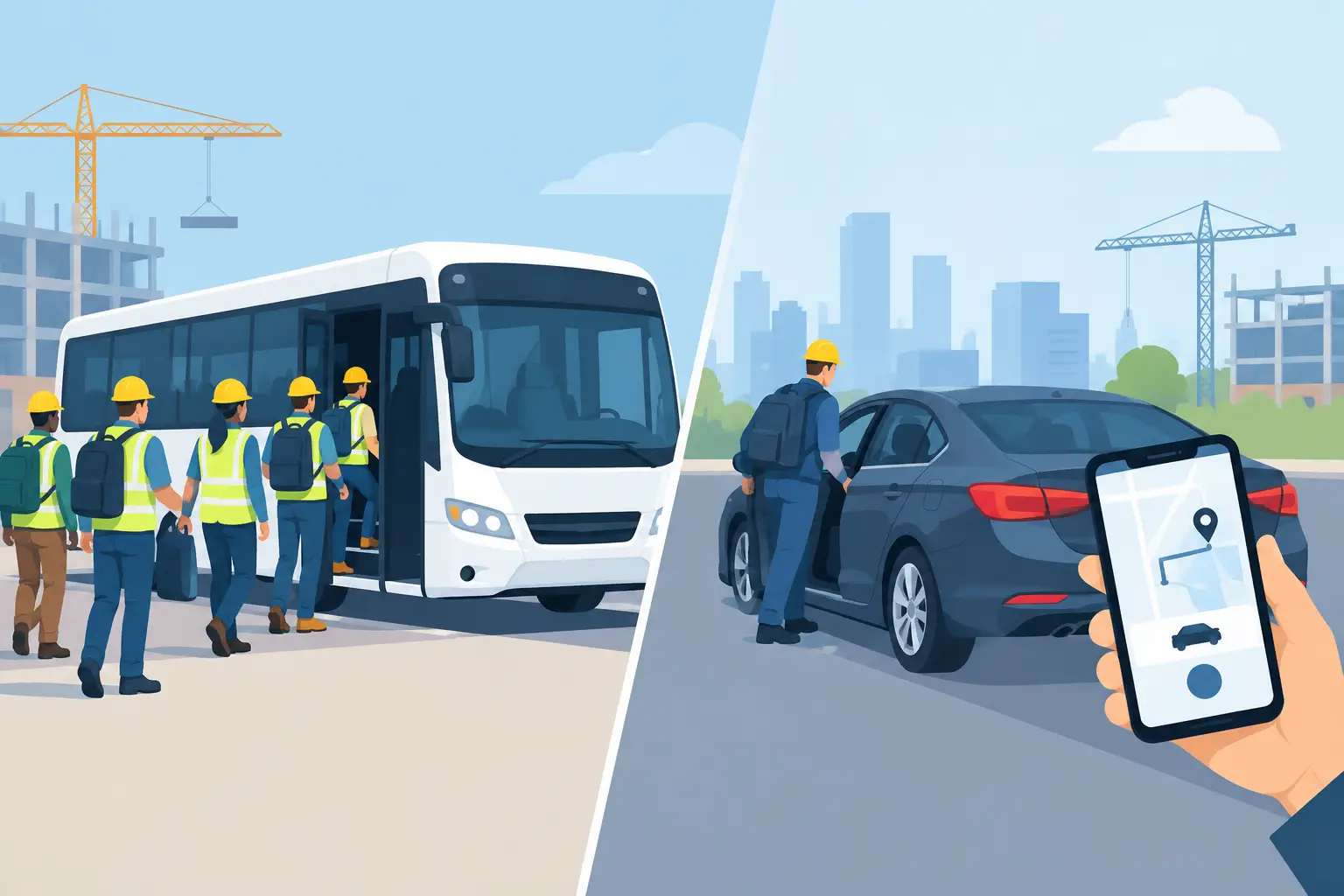
A 7:00 a.m. shift does not start at 7:00 a.m. if half the crew is still waiting for separate cars. For operations teams, the private shuttle versus ride hailing decision is not just about getting from point A to point B. It affects attendance, shift handovers, site access, budget control, and how calmly each workday begins.
Ride-hailing apps are useful for an individual employee, a last-minute visitor, or a small urgent trip. But when a company moves people every day, especially across multiple shifts, booking separate vehicles can become difficult to manage. A private shuttle gives the business one planned route, one pickup schedule, and one accountable transport partner.
Private Shuttle Versus Ride Hailing: The Main Difference
Ride hailing is designed for on-demand individual travel. A passenger books a car when needed, waits for a driver to accept, and travels directly or with a few companions. This works well when passenger numbers are low and timing is flexible.
A private shuttle is organized around the group. The vehicle, driver, pickup points, route, and operating times are arranged in advance. A 13-seat minibus, 23-seat bus, or 40-seat bus can collect employees from designated locations and bring them to a factory, office, construction site, dormitory, or event venue together.
The difference becomes clear during peak periods. If 20 workers need to arrive at an industrial site before a shift starts, ride hailing requires multiple successful bookings at the same time. A shuttle requires one vehicle plan. That is why recurring staff transport is usually better managed as a shuttle service rather than a series of daily app bookings.
When Ride Hailing Makes Sense
Ride hailing still has a place in a practical transportation plan. It can be a sensible choice for a manager traveling alone, an executive heading to a meeting, or a staff member who needs a one-time trip outside the usual route. It is also useful when a pickup is genuinely unpredictable and no group movement is involved.
For small groups, ride hailing may be convenient if travelers can split across vehicles and are not carrying much equipment or luggage. A one-off airport trip for one or two people, for example, may not require a dedicated vehicle.
The trade-off is control. Fares can change with demand, drivers may be farther away during busy periods, and vehicles may not have the space needed for tools, safety gear, bulky materials, or multiple passengers. A team may arrive in separate batches, which is inconvenient when site induction, security clearance, or a joint departure is required.
Ride hailing also puts the coordination work back on the company. Someone must make sure every employee has booked correctly, reached the right entrance, and submitted the right expense claim. For occasional trips, that may be acceptable. For daily workforce movement, it often creates avoidable admin.
Why Private Shuttles Work Better for Recurring Staff Transport
A dedicated shuttle is built for repeatability. Employees know where to wait, what time the vehicle will arrive, and where they will be dropped off. Supervisors know how many seats are available and can communicate a single transport plan to the team.
This predictability matters when workers travel early in the morning, late at night, or between locations with limited public transportation options. It is especially valuable for factories, construction sites, warehouses, and worksites operating on rotating shifts. When transport runs consistently, teams are more likely to arrive together and ready to work.
A private shuttle can also be adjusted as operations change. A company may need to add a dormitory pickup, change the reporting time for a night shift, create a separate route for a larger department, or provide transport for overtime work. These are operational changes, not exceptional requests, and the transport arrangement should be able to follow them.
Singapore Workers Transport plans recurring employee pickup and drop-off services around actual work schedules, passenger volumes, and pickup locations. This can include 13-, 23-, and 40-seat vehicles for daily staff movement, with professionally driven, licensed, and insured transport arranged for the route.
Capacity is more than a seat count
The cheapest option is not always the best value if it leaves people standing at pickup points or forces the company to book extra cars. Capacity planning should account for regular passengers, expected growth, shift changes, and what people need to carry.
A minibus may suit a small office team or a site supervisor group. A larger bus is often more efficient for a full workforce movement from a dormitory, MRT-area pickup point, or central meeting location. For airport transfers, events, and executive travel, a 6- to 13-seat vehicle may be the better fit depending on luggage and comfort requirements.
The vehicle should match the trip, not just the passenger count. A group traveling with luggage, samples, bicycles, wheelchairs, or work equipment needs more space than a group making a short commute with only personal bags.
Punctuality has a direct operating value
When each employee books a separate ride, the organization depends on several drivers, traffic conditions, app availability, and individual decisions. One delayed car might not stop the day, but repeated late arrivals create pressure on supervisors and disrupt handovers.
With a private shuttle, the pickup order and departure time are agreed in advance. The driver is assigned to the route, and the group travels together. Traffic can still happen, particularly during peak hours, but a planned transport service gives the business a clear schedule and a contact point if adjustments are needed.
For companies with strict reporting times, it is wise to set pickup times with a practical buffer. A good route plan considers travel distance, known congestion areas, site entry procedures, and the time needed for all passengers to board safely.
Comparing Costs Beyond the Fare
Ride-hailing prices can appear attractive for a single trip. The picture changes when a business pays for several cars, twice a day, across six or seven workdays. Surge pricing, cancellation fees, waiting time, and individual expense claims can make the monthly cost harder to predict.
A private shuttle generally provides a clearer basis for budgeting. The company can arrange a point-to-point service, hourly transport, or a recurring contract based on the route and vehicle size. Instead of reconciling dozens of individual receipts, the transport cost is tied to a defined service arrangement.
That does not mean a shuttle is automatically the right choice for every group. If passenger numbers change daily from two people to 20 people, a fixed bus may not be cost-effective without careful planning. In that case, a flexible arrangement with the right vehicle size, or a combination of scheduled group transport and approved ride hailing for exceptions, may be more practical.
The right comparison includes administrative time as well as fare. Consider who books the trips, who answers late-night transport questions, who handles reimbursement, and what happens when multiple staff members cannot secure a car during a busy period.
Questions to Ask Before Choosing
Before deciding between a private shuttle and ride hailing, review the actual movement pattern rather than only the price of one trip. Four questions usually reveal the better option:
- How many passengers travel on the same route at the same time, and how often?
- Are shift start times strict, including early-morning, late-night, or weekend operations?
- Do employees carry equipment, uniforms, luggage, or other items that need vehicle space?
- Does the business need predictable monthly spending and one point of contact for transport changes?
If the answer points to recurring group travel, a private shuttle is usually the stronger operational choice. If travel is irregular, low-volume, and individual, ride hailing may remain useful.
A Practical Hybrid Approach
Many organizations do not need to choose only one method. A daily shuttle can cover core staff routes, while ride hailing handles exceptional needs such as a late-finishing employee, an urgent document run, a visitor pickup, or an executive meeting across town.
This approach protects the routine without overcommitting vehicles where they are not needed. The key is setting clear rules. Staff should know which journeys are covered by the scheduled shuttle, who can approve an exception, and how to report a missed pickup or schedule change.
For events and one-time group movements, booking a dedicated maxicab, minibus, or bus often keeps the group together without creating a recurring contract. For airport transfers or VIP travel, an executive MPV can provide the additional luggage space and comfort that standard ride-hailing vehicles may not reliably offer.
A transport plan should make the workday easier for the people responsible for it. When a group needs to arrive safely, on time, and together, start with the route, the shift schedule, and the passenger count. The right vehicle arrangement will usually become clear from there.