


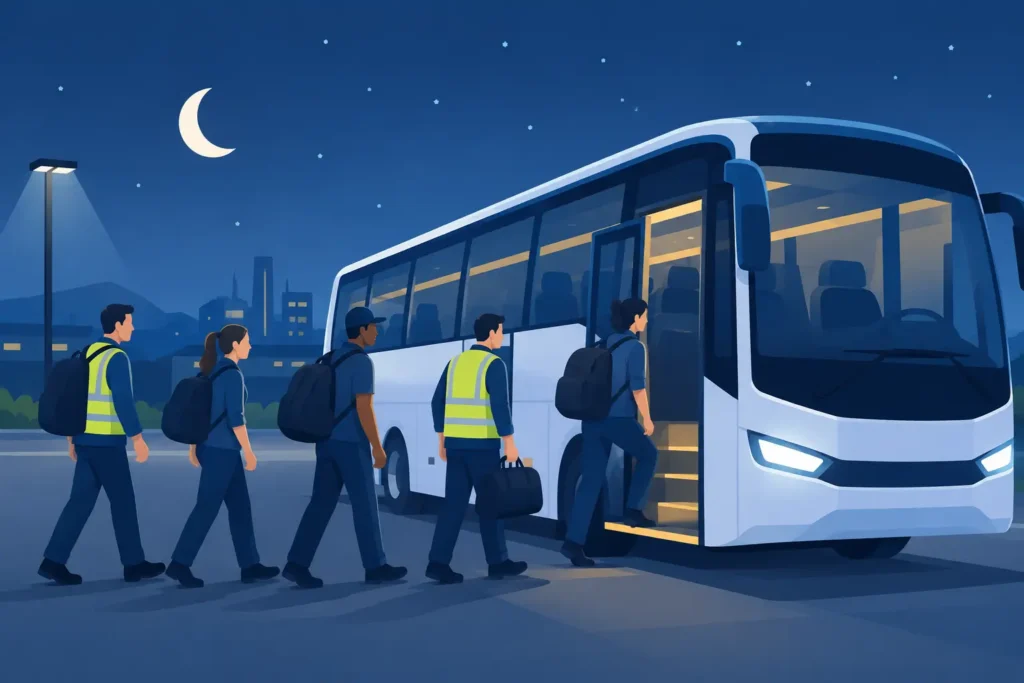
A 7:00 p.m. shift change can look simple on a roster and become difficult on the road. Workers may be finishing a long day, starting a night shift, carrying equipment, or traveling from dormitories and residential areas to industrial sites with limited late-night public transport. A missed pickup can delay a production line. A rushed journey can create a safety risk. To transport workers safely overnight, employers need more than a vehicle and a driver. They need a planned service that works reliably when roads, schedules, and staffing needs change.
For factories, construction sites, warehouses, offices, and other round-the-clock operations, worker transport is part of daily site management. The right arrangement protects attendance, supports employee well-being, and gives supervisors a clear point of contact when plans change.
Start With Shift Times, Not Vehicle Availability
Overnight transport should be built around the actual movement of people. Begin with shift start and end times, including handover periods, security checks, meal breaks, and the time workers need to walk from the drop-off point to their work area. A bus that arrives exactly at shift start is not punctual if employees still need 10 minutes to enter the site and get ready.
Build a pickup schedule with enough buffer for common delays, especially during rain, roadworks, and peak shift-change periods. The goal is not to make workers wait unnecessarily early. It is to give the operation enough protection against a late arrival. For a critical shift, planning arrival 15 to 30 minutes before reporting time is often more practical than aiming for a last-minute drop-off.
The route matters just as much as the timetable. A direct route may be faster, but it can be unsuitable if it requires workers to wait at an isolated roadside location. Grouping pickup points near dormitories, MRT stations, worker housing, or well-lit access points can improve both reliability and personal safety. Routes should also be reviewed when headcount, worksites, or shift patterns change.
Match Capacity to the Real Passenger Load
Overcrowding is not a cost-saving measure. It creates discomfort, can affect safe boarding and alighting, and makes it harder for a driver to account for passengers. The vehicle should be selected for the confirmed headcount, with reasonable allowance for new hires, relief staff, or occasional visitors.
Smaller teams may be well served by a 6- to 13-seat vehicle such as a Toyota Noah, Voxy, Viano, or HiAce. Larger recurring groups may require a 13-, 23-, or 40-seat minibus or bus. For night transport, capacity planning should also consider bags, safety gear, lunch containers, and work equipment. A vehicle that technically seats everyone may not be comfortable or practical when workers carry bulky items.
The best vehicle choice depends on route length and passenger needs. A short shuttle from a dormitory to a nearby site may prioritize efficient boarding and frequent trips. A longer cross-island journey may call for more legroom, dependable air conditioning, and space for belongings. If workers include passengers with mobility needs, plan the boarding arrangement before the first trip rather than trying to solve it during a busy shift change.
Use Drivers Who Understand Overnight Work
Night driving requires a different level of awareness. Visibility is lower, fatigue can affect other road users, and pickup locations may be quieter or less familiar than daytime stops. Employers should work with a transport provider that uses professional, properly licensed drivers and maintains insured vehicles for passenger service.
A driver also needs clear operational information. This includes the pickup sequence, site entry instructions, approved waiting areas, shift supervisor contact details, and procedures for late passengers. When drivers are left to guess where to stop or who to call, small issues become delays that affect the entire route.
Driver fatigue must be treated seriously. A provider handling recurring overnight schedules should roster drivers responsibly and avoid assigning unrealistic runs that leave no time for rest, refueling, vehicle checks, or traffic delays. The lowest quoted rate is not always the lowest operational cost if it results in inconsistent service, frequent driver changes, or missed pickups.
Make Pickup and Drop-Off Points Safer
A safe transport plan continues beyond the vehicle door. Workers should board and alight at locations with adequate lighting, clear access, and enough room for the vehicle to stop without blocking traffic. Avoid asking people to cross busy roads, walk through poorly lit areas, or wait alone in places where they cannot easily see the arriving vehicle.
At worksites, confirm whether the vehicle can enter the premises, where it should stop, and whether a security checkpoint or vehicle pass is required. Some industrial and construction locations have strict access rules that can add time to every trip. Building those requirements into the schedule prevents workers from being dropped outside a gate with no clear onward arrangement.
Communication helps here. Workers should know the pickup point, scheduled time, vehicle type, and whom to contact if they are delayed. Supervisors should have the driver or transport coordinator’s contact details for last-minute changes. WhatsApp or SMS updates are especially useful for overnight operations because they provide a fast way to notify a group about weather delays, road closures, or a revised pickup point.
Plan for Exceptions Before They Happen
No overnight transport schedule stays perfect forever. Overtime, urgent maintenance work, a delayed delivery, or a sudden increase in manpower can create a transport gap. The practical answer is to agree on escalation procedures before the service begins.
For recurring contracts, decide who is authorized to request an additional vehicle, change a route, or cancel a trip. Provide a current passenger count and identify which journeys are business-critical. If one group must reach a worksite on time to keep operations running, that journey should have priority when resources are stretched.
It is also sensible to keep a contingency option for unusual movements. This may be a standby minibus for major shift changes, an on-demand maxicab for a small group, or an hourly booking for teams whose finishing time cannot be predicted. A flexible arrangement costs more than a fixed schedule, but it can prevent far higher costs from delayed work or employees being stranded after midnight.
Review Performance With Operational Data
Reliable overnight transport is measurable. Track actual pickup and arrival times, passenger counts, missed trips, no-shows, route changes, and common causes of delay. This does not need to become a complicated reporting exercise. Even a monthly review can reveal whether a pickup point is consistently slow, a vehicle is too small, or a planned route no longer matches worker locations.
Ask site supervisors and workers for feedback as well. Drivers may see traffic patterns, but passengers can identify issues such as insufficient lighting, unsafe waiting areas, or a route that leaves them walking too far after drop-off. Good transport planning combines timetable data with the experience of the people using the service every night.
When staffing grows, revisit the arrangement promptly. Adding several workers across different pickup points can turn a once-efficient route into a long and unreliable trip. Splitting the route, changing the vehicle size, or creating a second collection point may improve punctuality without greatly increasing cost.
How Singapore Workers Transport Supports Night Shifts
Singapore Workers Transport provides 24/7 workforce transport for organizations that need employees moved safely and punctually across Singapore. Recurring pickup and drop-off routes can be customized for factories, construction sites, offices, dormitories, and industrial facilities, with vehicle options from smaller vans to 13-, 23-, and 40-seat buses.
For operations managers, the value is not simply having a bus available. It is having a practical transport partner that can align vehicle capacity, route planning, pickup timing, and responsive communication with the reality of shift work. One-time group movements, overtime trips, airport transfers, and larger event transport can also be arranged when staffing plans extend beyond the usual route.
A dependable overnight ride tells workers that their time and safety are part of the operation, not an afterthought. Set the route carefully, keep communication clear, and give every shift a reliable way home or to work.