




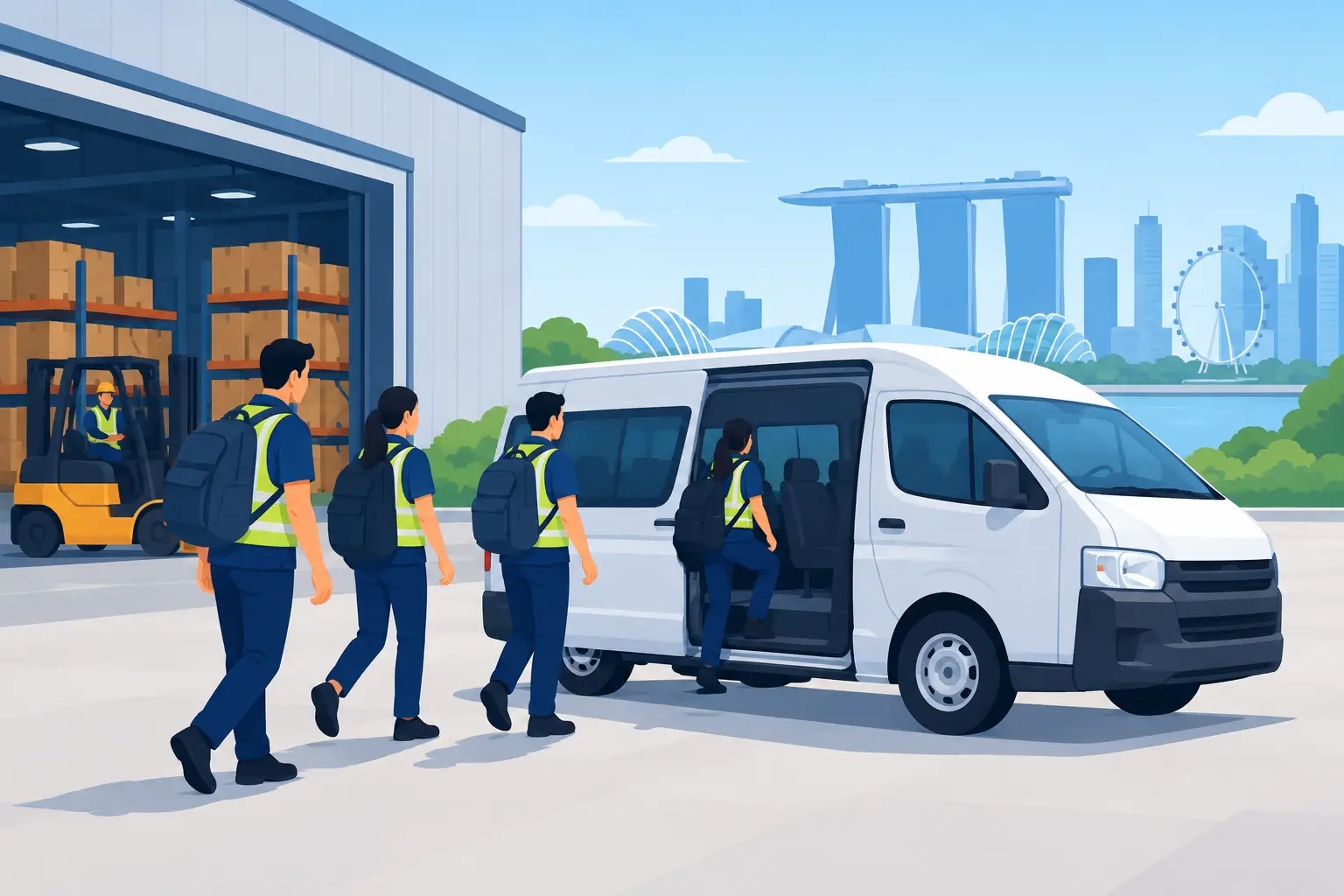
A warehouse shift does not start when the first pallet moves. It starts when the team arrives at the site, ready to work, with enough time to change, check in, and take up their assigned stations. When employees depend on multiple public transport connections, late-night ride bookings, or informal carpooling, a small delay can affect receiving, picking, packing, and dispatch for the whole operation.
Warehouse staff transport Singapore businesses arrange for their teams is therefore more than a staff benefit. It is a practical way to protect shift attendance, improve workforce safety, and keep daily logistics predictable. For warehouses in industrial estates, logistics parks, port-adjacent areas, and locations with limited direct transit access, a scheduled staff shuttle can remove a recurring operational problem.
Why warehouse transport affects daily output
Warehouses operate on timing. A morning inbound delivery may need a full receiving crew. A late shift may be responsible for loading vehicles before a fixed collection deadline. If several workers arrive late because of rain, a missed bus connection, or a lack of available transport after midnight, supervisors are left reallocating staff instead of running the floor.
A dedicated employee transport arrangement gives managers more control over the beginning and end of each shift. Workers can be collected from agreed pickup points and brought directly to the warehouse, factory, dormitory, or distribution center. The route is planned around actual reporting times, rather than forcing employees to fit their commute around a general public schedule.
This matters especially for rotating shifts. A route that works well for an 8:30 a.m. office start may not work for a warehouse team reporting at 6:45 a.m., finishing at 11:00 p.m., or changing between day and night schedules. Reliable transport reduces uncertainty for employees and makes staffing plans more realistic for operations managers.
Start with the shift pattern, not the vehicle
The right warehouse staff transport Singapore plan begins with a clear picture of movement demand. Many companies make the mistake of choosing a bus size first, then trying to fill it. A better approach is to map who needs transport, where they start, and when they must be on site.
Review the number of employees per shift, their general residential areas or dormitory locations, and the reporting window required before work begins. Also identify whether the same people travel every day or whether staffing changes frequently due to overtime, temporary workers, or agency assignments.
A 13-seat minibus can be a sensible choice for a small team traveling from one or two concentrated pickup points. A 23-seat vehicle may suit a department-sized group or a route serving several nearby locations. For larger warehouse operations, a 40-seat bus can move a full shift efficiently and reduce the need for multiple vehicles arriving at different times.
Vehicle capacity should include some breathing room. Booking exactly the number of seats needed can become difficult when new employees join, workers bring approved items, or a team member needs to switch shifts. On the other hand, paying for a much larger bus than the route requires can raise transport costs without improving service. The best fit depends on headcount stability, pickup geography, and how often schedules change.
Build routes around realistic travel times
A short route on a map is not always the fastest route at shift change. Industrial areas can see heavy traffic when several companies start or end work at the same time. Gate queues, security checks, loading activity, and road works can also add time that does not appear in a standard journey estimate.
Allow enough buffer for workers to board, for drivers to reach the facility safely, and for the team to arrive before the shift briefing. It is usually better to schedule arrival 15 to 20 minutes before reporting time than to aim for an exact start-time arrival with no margin for disruption.
Pickup points should be easy to recognize and safe for boarding. Common meeting points include MRT exits, neighborhood bus stops where stopping is permitted, worker dormitories, and designated transport bays. Avoid adding too many stops simply to make the route convenient for every individual. Each extra stop can turn a dependable commute into a long and tiring journey for the whole group.
Match the service to your warehouse operation
Not every warehouse needs the same arrangement. A fixed daily shuttle is often the most efficient option for stable headcount and recurring shifts. It gives employees a known pickup time and gives management an attendance pattern that is easier to monitor.
Some operations need more flexibility. Peak-season hiring, stock counts, major deliveries, company training, or a temporary relocation may call for additional vehicles on specific days. A transport provider with different minibus and bus capacities can support these changes without forcing the business into a one-size-fits-all arrangement.
For smaller management teams, site visitors, or executives traveling between offices and warehouses, a 6- to 13-seat MPV or van may be more suitable than a full shuttle bus. Premium vehicles can also be appropriate when moving clients, auditors, or regional leadership, while standard minibuses remain the practical choice for daily workforce travel.
Singapore Workers Transport supports recurring employee pickup and drop-off services with 13-, 23-, and 40-seat vehicles, alongside smaller MPVs and vans for group transfers. That range is useful when a warehouse has both daily staff movements and occasional business travel requirements.
Put safety and driver professionalism first
Affordable staff transport should not mean cutting corners. Warehouse employees may travel before sunrise, after late shifts, or during periods of heavy rain. A professionally driven, licensed, and insured vehicle gives workers a safer alternative to waiting alone for irregular transport or arranging rides at the last minute.
Driver professionalism also shapes the employee experience. Drivers should understand the pickup schedule, use approved stopping points, maintain a safe and respectful environment, and communicate quickly if a route is affected by traffic or an unexpected closure. For site supervisors, a responsive contact person is just as valuable as the vehicle itself when an urgent schedule adjustment is needed.
Comfort has a practical role too. Workers who travel long distances before a physically demanding shift need a clean, air-conditioned vehicle and a reasonable journey length. Comfortable transport will not solve every retention issue, but it signals that the employer has considered the realities of getting to and from work.
Control costs without creating hidden problems
The lowest quoted rate is not always the lowest operational cost. A route that is too long, poorly timed, or frequently delayed can contribute to absenteeism, overtime, and supervisor time spent resolving transport issues. These costs are harder to see than a daily vehicle rate, but they affect the operation over time.
When requesting a transport proposal, provide the shift timings, pickup areas, expected headcount, service days, and whether the arrangement is ongoing or temporary. Ask how route changes, extra trips, waiting time, and public holiday requirements are handled. Clear pricing and clear operating expectations prevent misunderstandings after service begins.
It can also help to review the route after the first few weeks. Employee locations may change, one pickup point may consistently cause delays, or a growing team may require a larger vehicle. A transport plan should be stable enough for workers to rely on but flexible enough to reflect actual operating conditions.
Questions to settle before service starts
Before the first trip, confirm who will provide the final passenger list, who is authorized to request changes, and how late additions or no-shows will be handled. Establish a simple communication process for serious weather, shift extensions, and emergency overtime. For night operations, make sure drop-off arrangements are considered as carefully as morning pickups.
Also agree on the warehouse entry procedure. Drivers may need gate clearance, a designated waiting area, or contact details for the site supervisor. These small details prevent avoidable delays at the point where the transport service meets the warehouse operation.
A well-planned staff shuttle gives employees a more dependable way to reach work and gives managers one less daily variable to chase. When your next shift is scheduled, the goal is simple: your people should arrive safe, on time, and ready for the work ahead.