




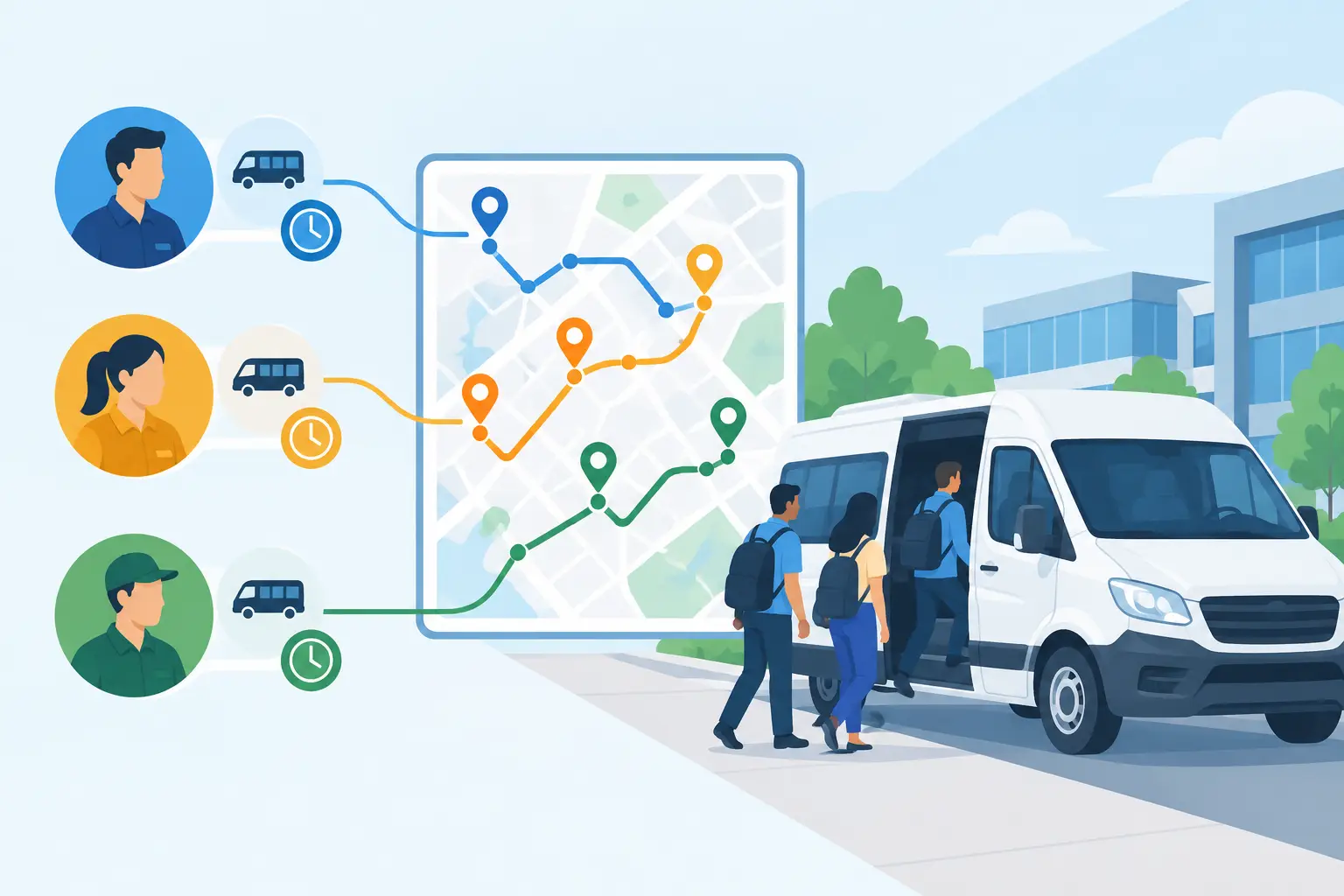
A late staff shuttle can hold up an entire production line, delay a site handover, or leave an office shift short-handed before the day starts. Knowing how to route employee pickups means more than putting addresses in order. It means building a daily transport plan that gets the right people to the worksite safely, comfortably, and on time, without paying for unnecessary distance or empty seats.
For Singapore businesses, the most effective employee pickup routes account for shift timing, residential clusters, vehicle capacity, traffic conditions, and the practical needs of workers. A route that looks shortest on a map may not be the most reliable once peak-hour congestion, dormitory access, loading space, and staggered reporting times are considered.
Start With the Worksite Schedule, Not the Home Addresses
The worksite reporting time is the fixed point of every route. Begin by confirming when each team must arrive, then work backward to set a realistic vehicle arrival time. A factory shift starting at 8:00 a.m. may require employees to be at the gate by 7:45 a.m. for attendance, safety briefings, or changing time. In that case, the shuttle should be scheduled to arrive before 7:45 a.m., not at 8:00 a.m.
Separate employees by shift whenever possible. Mixing day-shift, night-shift, overtime, and office staff into one route can create long waiting periods and frequent schedule changes. If a smaller group has a different reporting time, a 6- to 13-seat vehicle may be more cost-effective than forcing a full-size bus to make multiple runs.
Also identify whether the worksite has more than one entrance. Construction projects, industrial facilities, and large business parks often have separate gates for staff, visitors, and deliveries. The drop-off point should be close to where employees actually need to report, while remaining safe and permitted for passenger loading.
How to Route Employee Pickups by Area
The simplest approach is to group employees by geography before deciding on the pickup sequence. Rather than planning around individual addresses, look for clusters around MRT stations, HDB estates, worker dormitories, or common meeting points. A designated pickup stop can serve several employees while keeping the route predictable.
For example, if workers live across Woodlands, Yishun, and Sembawang, avoid a route that crosses back and forth between neighborhoods to collect people one by one. Start at the outermost cluster, move toward the worksite, and minimize backtracking. This usually reduces mileage and makes it easier for passengers to understand their pickup timing.
A door-to-door service can be suitable for executives, employees with mobility needs, or small teams working unusual hours. For larger workforce movements, central meeting points are generally more efficient. The trade-off is convenience versus route discipline. Too many individual stops can make a bus late even when every passenger is ready on time.
When choosing a pickup point, check the conditions on the ground. A good stop should have enough space for the vehicle to pull in safely, clear instructions for passengers, and minimal risk of blocking traffic. Stops near busy junctions, narrow roads, school zones, or active loading bays may look convenient but can cause daily delays.
Set a Practical Stop Limit
There is no single perfect number of stops, but each additional stop adds more than the time needed to open the door. It also adds time for slowing down, turning in, waiting for late passengers, and rejoining traffic. For a recurring staff shuttle, fewer well-used stops are usually better than many lightly used ones.
Review any stop with only one regular passenger. If that employee can safely walk to a nearby pickup point shared by others, consolidating the stop may make the entire route more reliable. This should be handled respectfully and with enough notice, particularly for night-shift staff or employees carrying work equipment.
Match Vehicle Capacity to Actual Ridership
Vehicle selection affects both cost control and punctuality. A vehicle that is too small creates crowded conditions and risks leaving staff behind. A vehicle that is too large can raise operating costs and become difficult to maneuver at smaller pickup points.
Use confirmed ridership, not headcount alone. If 40 employees are assigned to a shift but only 28 normally use company transport, plan around the expected passenger count while keeping a reasonable buffer for new hires and temporary changes. Attendance patterns should be reviewed regularly, especially after manpower changes, project transfers, or shift adjustments.
A 13-seat minibus can work well for a small office team or a satellite shift. A 23-seat bus may suit a single dormitory cluster and nearby estates. A 40-seat bus is often the practical choice for larger factory, warehouse, and construction-site movements. If workers are distributed across several areas, two smaller vehicles on direct routes can sometimes outperform one large bus on a long, winding loop.
Comfort matters as well. Staff arriving after a long ride in an overcrowded vehicle may begin work tired and frustrated. Proper seating, air-conditioning, and professionally maintained vehicles support a safer, more dependable commute.
Build Time Buffers Where Delays Actually Happen
A route should not rely on every traffic light, passenger, and security checkpoint going perfectly. Add a realistic buffer based on the route’s risk points. Morning peak traffic, rainy weather, expressway merges, school zones, industrial-estate entrances, and security checks all need consideration.
The buffer should be placed thoughtfully. A few extra minutes before the final worksite arrival can absorb small delays without forcing employees to wait too long at their pickup points. If congestion is consistently severe at one section, consider changing the pickup order or using a different approach road rather than simply moving every pickup earlier.
For shift changes, allow time for buses to enter, unload, turn around, and leave safely. Sites with limited driveway space may need staggered arrivals so that several staff buses do not queue at the same gate. Coordinating this with site security or facilities management prevents last-minute confusion.
Plan for Late Passengers Without Delaying Everyone
A clear late-passenger policy protects the route. Drivers should have a confirmed manifest, designated pickup times, and a reasonable waiting limit. If a passenger is not present after that limit, the vehicle should continue unless a supervisor gives specific instructions.
This may sound strict, but an employee shuttle serves the entire group. Waiting five minutes at two stops can turn into a 15-minute late arrival for everyone else. Share the policy during onboarding and send pickup details through the communication channel employees use most, such as a group message or company notice.
When a staff member’s address, shift, or worksite changes, update the route before the next service day. Small unreported changes are a common cause of empty stops, missed pickups, and overloaded vehicles.
Use a Daily Operating Checklist
Even a well-designed route needs consistent daily execution. Before departure, the driver or transport coordinator should confirm the vehicle assignment, driver contact details, passenger list, pickup sequence, worksite gate, and any temporary road or site-access restrictions.
For recurring services, keep one version of the route plan that everyone can follow. It should include stop names, target pickup times, passenger counts, contact persons, and escalation instructions. Avoid relying on verbal changes passed from one person to another. A written operating plan reduces mistakes when a relief driver is assigned or a supervisor is unavailable.
It also helps to track actual performance for at least the first two weeks of a new route. Record departure time, arrival time, passenger count, no-shows, waiting time, and repeated traffic delays. This turns route planning from guesswork into a practical improvement process.
Review Routes When Operations Change
Employee transportation routes should not be treated as permanent once they are launched. Review them whenever headcount changes, a new dormitory opens, reporting times shift, or a project moves location. A route that was efficient three months ago may now be too long, too expensive, or poorly matched to current staffing.
Ask site supervisors and passengers for focused feedback. Are pickups consistently early or late? Is one stop difficult to access? Are certain buses regularly underfilled? The best adjustments are usually small: moving a stop, changing the pickup order, assigning a different vehicle, or splitting one overloaded route into two.
For businesses managing multiple shifts and worksites, a professional transport partner can coordinate these adjustments, provide suitable bus capacities, and maintain clear driver communication. Singapore Workers Transport supports customized recurring staff routes for factories, offices, construction sites, dormitories, and other daily workforce movements.
A reliable pickup route gives employees a calmer start to the shift and gives managers one less operational issue to chase. Start with real attendance data, keep stops practical, protect the schedule with sensible buffers, and review performance often. Those habits make daily staff transport easier to manage as your workforce changes.